
Phoradendron randiae
Phoradendron randiae
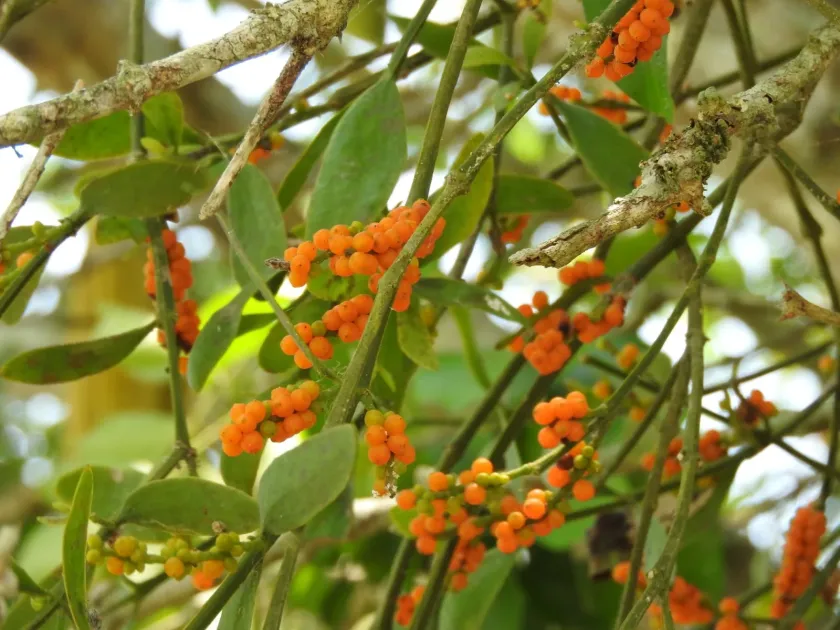
Description
Growing requirements
Phoradendron randiae is a member of the Santalaceae family, functioning as a hemi-parasitic shrub. It is not cultivated for agricultural gain but is studied for its ecological role and impact on host tree health.
Native to Mexico, this species is well-adapted to semi-arid environments. It exclusively targets specific host trees, such as those within the Randia genus, to derive water and essential mineral nutrients through specialized structures.
The plant exhibits distinct morphological features including succulent, photosynthetic stems and opposite leaves. Its ability to perform photosynthesis allows it to supplement its carbon supply, distinguishing it from full parasites.
The plant thrives under full sunlight exposure, which is typical for its semi-arid habitat. It utilizes the host tree's vascular system via haustoria to sustain its water requirements during long periods of drought.
From an agricultural standpoint, Phoradendron randiae is considered a pest. Its growth requires no cultivation efforts, but rather systematic removal to prevent the decline of valuable timber or fruit-bearing trees.
Main diseases and pests
The primary threat posed by Phoradendron randiae is the physiological stress it inflicts upon the host tree. Excessive attachment can weaken branches and reduce the host's overall productivity and lifespan.
Natural pests, such as wood-boring insects and foliage-feeding larvae, often utilize the parasite, though they rarely provide sufficient control to eradicate the plant from the host.
Disease development within the parasite is minimal; however, structural damage to the host tree at the attachment point can create entry sites for secondary fungal infections and wood-rotting pathogens.
Effective management requires manual pruning of infected branches. It is critical to cut deep enough into the host wood to ensure that the haustorial system of the parasite is completely removed.
The seed dispersal mechanism, primarily facilitated by frugivorous birds, makes control measures challenging. Managing bird habitats or using protective netting can be considered in high-value orchard settings.