
Phoradendron bolleanum
Phoradendron bolleanum
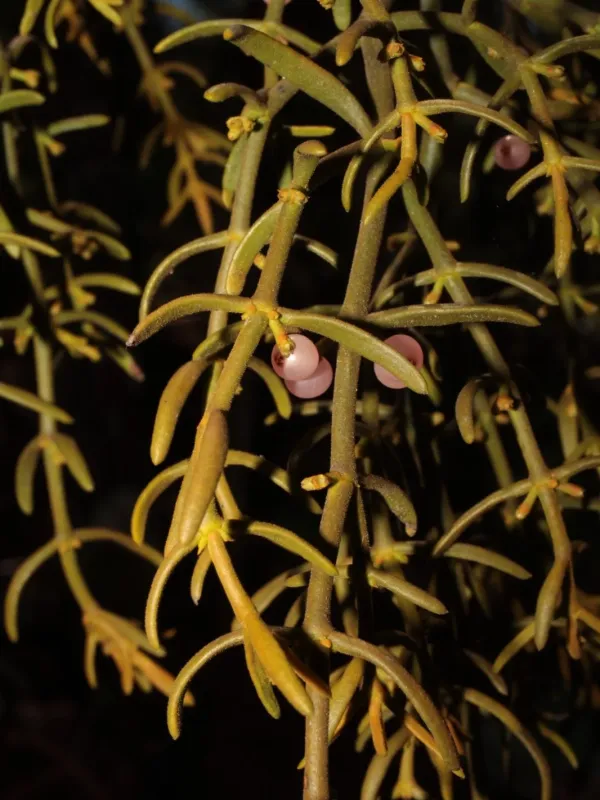
Description
Growing requirements
Phoradendron bolleanum is a perennial hemiparasitic plant belonging to the Santalaceae family. It is distinct in its adaptation to arid environments, where it functions as an epiphyte on woody hosts, primarily species of the genus Juniperus.
The plant originates from the desert and semi-desert regions of North America, particularly throughout Mexico and parts of the southwestern United States. Its ability to extract water and nutrients from the host allows it to thrive in regions where ground-water availability is limited.
Botanically, it exhibits succulent-like features with thick, leathery leaves designed to minimize transpiration. The plant establishes a connection to the host’s vascular system via haustoria, which penetrate the bark of the host tree to siphon xylem sap.
Climatic requirements are specific to high-light environments with moderate to low humidity levels. As a parasitic species, its growth cycle is heavily synchronized with the physiological health and seasonal activity of the host tree.
Cultivation of this species is not practiced in agriculture, as it is strictly a wild species. Understanding its biological requirements is essential for conservation efforts and studying the parasite-host relationships in native ecosystems.
Main diseases and pests
The primary threat to the stability of Phoradendron bolleanum populations is the degradation and deforestation of host tree habitats. The loss of juniper forests directly translates to the loss of available space for this species.
Fungal pathogens can compromise the structural integrity of the haustorial attachment point, leading to the detachment and subsequent death of the parasite. Such infections are often exacerbated by unusually humid or stagnant air conditions.
Insect pests typically have limited impact due to the presence of secondary metabolic compounds in the foliage that deter herbivory. However, localized damage to stems can occur under high population density of specific beetles.
Environmental stress, such as extreme heatwaves or drought that kills the host tree, acts as a primary limiting factor. If the host suffers, the parasite inevitably perishes, making the health of the tree-host the most critical factor.
Ornithochory, or seed dispersal by birds, is vital for the survival of the species. Any decline in local bird populations or disruption of their migratory patterns significantly restricts the expansion and colonization of new hosts.