
American mistletoe
Phoradendron leucarpum
Description
Growing requirements
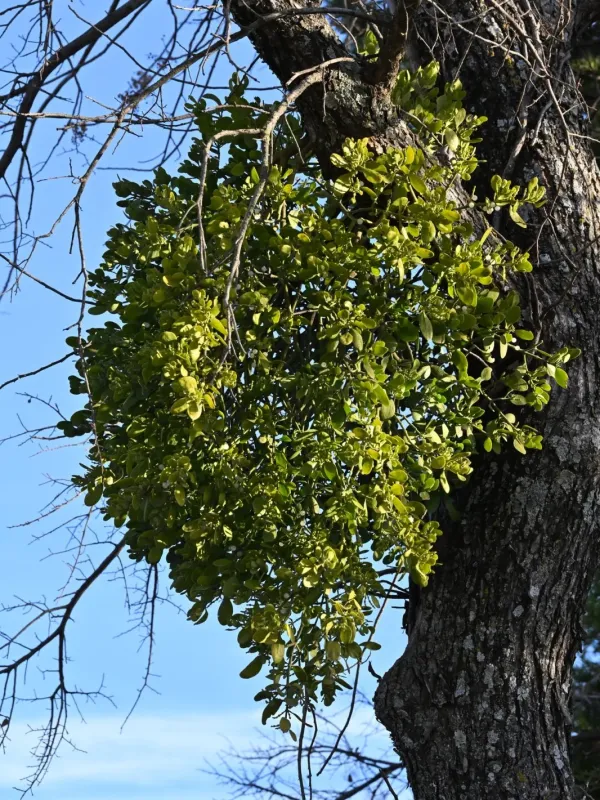
American mistletoe (Phoradendron leucarpum) is a prominent species of hemiparasitic plant belonging to the Santalaceae family. It is native to North America and is well-known for its ability to grow on the branches of various deciduous trees.
The plant derives water and nutrients from its host through specialized root-like structures called haustoria, which penetrate the xylem of the host plant. Despite being parasitic, it retains green leaves and performs photosynthesis, making it a hemiparasite.
Its natural habitat spans diverse environments across the United States, typically found in hardwood forests. It thrives in climates that provide sufficient warmth for fruit development and has adapted to survive in various sunlight conditions.
Unlike traditional crops, this species does not require soil cultivation or complex nutrient management. Its survival depends entirely on the health and vitality of the host tree, demonstrating a complex evolutionary relationship with forest ecosystems.
Botanically, the plant features leathery, evergreen leaves and clusters of white, translucent berries. These fruits are essential for wildlife, especially birds, which ingest the berries and deposit seeds onto new branches, facilitating its spread.
Main diseases and pests
In forest management, the plant is often viewed as a pest that can stunt the growth of timber trees. Severe infestations can weaken host branches, leading to structural instability, particularly during strong winds or ice storms.
Diseases affecting this species often involve fungal infections that thrive in dense foliage environments. These pathogens can compromise the plant's ability to extract nutrients, naturally regulating the population density within a forest.
Insect pests include various mites and beetles that target the foliage and berries. These organisms play a role in limiting the reproductive success of the plant, preventing it from overwhelming the host tree entirely.
Climate change poses a risk to the distribution of this species, as it alters the health of host trees and the timing of fruit production. Environmental stresses can lead to localized declines in plant populations.
Practical management strategies often involve silvicultural practices such as thinning and selective branch pruning. Maintaining a healthy balance in the forest ecosystem remains the best way to handle the presence of this hemiparasitic plant.