
Hairy Phoradendron
Phoradendron tomentosum
Description
Growing requirements
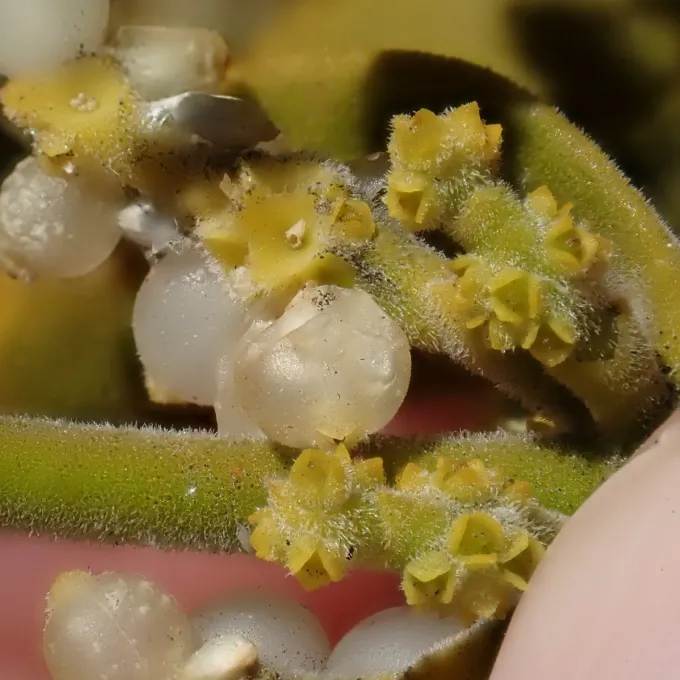
Hairy Phoradendron (Phoradendron tomentosum) is a perennial hemiparasitic plant belonging to the Santalaceae family. It is recognized for its dense, hairy foliage, which provides a distinctive silver-gray appearance and aids in water retention within arid environments.
The plant functions as a semi-parasite, relying on a specialized root system known as haustoria to extract water and nutrients from host trees. It does not grow in soil, instead anchoring itself firmly onto the branches of various hardwoods like oaks and poplars.
Geographically, it is native to the southern United States and northern Mexico. Its survival depends entirely on the health and vitality of the host tree, which serves as a perennial source of hydration and structural support throughout the year.
Environmental conditions require regions with relatively mild winters, as the plant remains evergreen and continues its metabolic activity even during colder months. High exposure to sunlight is beneficial, as the plant performs its own photosynthesis alongside its parasitic intake.
The distribution of this species is highly dependent on avian species, which consume the berries and transport seeds to new host branches. Without these bird populations, the spread of the Hairy Phoradendron in a given area would be significantly limited.
Main diseases and pests
Various insect species specialize in feeding on the leaves of Phoradendron, often creating significant defoliation during peak growth seasons. Fungal infections also occur, particularly during periods of high humidity, which can lead to the deterioration of the haustorial connections.
While often considered part of the natural biodiversity, in urban or managed forest environments, it is viewed as a pest. Severe infestations can put excessive physical stress on the host trees, requiring careful pruning management to maintain the host's long-term health.