
Dense mistletoe
Phoradendron macrophyllum
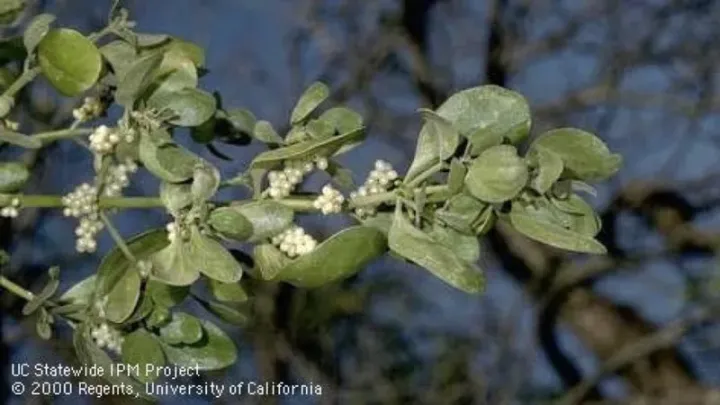
Description
Growing requirements
Phoradendron macrophyllum, commonly known as dense mistletoe, belongs to the Santalaceae family. It is a perennial evergreen shrub that grows as a hemi-parasite on the branches of various deciduous trees.
The native distribution covers large regions of North America, including the southwestern United States and Mexico. It is frequently found on species like cottonwoods, willows, and sycamores in riparian areas.
The plant has no true roots in the ground. Instead, it develops a haustorium, a specialized attachment organ that penetrates the bark of the host tree to tap into the xylem for water and minerals.
Dense mistletoe thrives in habitats with high light intensity. Being a hemi-parasite, it performs photosynthesis but relies on the host for hydration and mineral nutrition, which determines its success in canopy colonization.
Temperature requirements are tied to the hardiness of the host species. It demonstrates high resilience to environmental fluctuations, allowing it to persist across different ecological zones within its range.
Main diseases and pests
A primary threat caused by this parasite is structural weakness in the host tree. Excessive mistletoe growth can lead to branch failure, especially during heavy snowfall or high wind events, due to the added weight.
Birds, particularly cedar waxwings and robins, are the main vectors. They consume the berries and deposit the seeds onto new host branches, facilitating the rapid expansion of mistletoe populations.
Physiologically, heavy infestations can reduce the growth rate of the host tree and cause crown dieback. This makes the host plant more vulnerable to subsequent attacks by wood-boring insects and drought stress.
Management usually involves pruning infested branches at least 30 centimeters below the point of infection. This helps to remove the internal haustorial system, which can persist within the branch wood.
While chemical treatments like growth regulators exist, they are often difficult to apply and may affect the host tree. Cultural management, such as selecting resistant tree species, is generally preferred in forestry.