
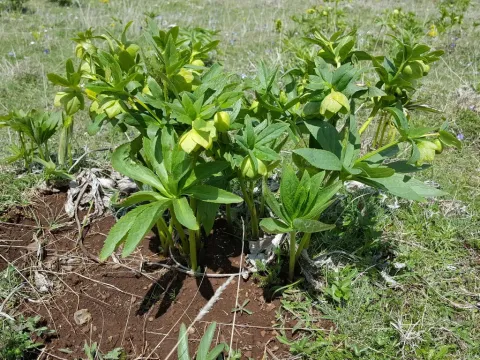
Hellebore
Helleborus L.
Sowing Hellebore seeds is best accomplished by planting them outdoors immediately after harvest in late summer or autumn. The seeds require a period of natural winter cold, known as stratification, to successfully break dormancy and germinate in the following spring.
What the section contains
 Christmas rose
Helleborus niger L.
Christmas rose
Helleborus niger L.
 Corsican hellebore
Helleborus argutifolius Viv.
Corsican hellebore
Helleborus argutifolius Viv.
 Corsican hellebore
Helleborus lividus Aiton subsp. corsicus (Briq.) P. Fourn.
Corsican hellebore
Helleborus lividus Aiton subsp. corsicus (Briq.) P. Fourn.
 Corsican Hellebore
Helleborus lividus Aiton x Helleborus niger L. x Helleborus x hybridus hort. ex Voss
Corsican Hellebore
Helleborus lividus Aiton x Helleborus niger L. x Helleborus x hybridus hort. ex Voss
 Dark-red hellebore
Helleborus atrorubens Waldst. & Kit.
Hellebore
Helleborus niger x Helleborus x hybridus
Dark-red hellebore
Helleborus atrorubens Waldst. & Kit.
Hellebore
Helleborus niger x Helleborus x hybridus
 Hellebore Sahinii
Helleborus x sahinii Grimshaw
Helleborus hybridus
Helleborus x hybridus hort. ex Voss
Hellebore Sahinii
Helleborus x sahinii Grimshaw
Helleborus hybridus
Helleborus x hybridus hort. ex Voss
 Helleborus lividus
 Aiton
Helleborus nigercors
Helleborus x hybridus hort. ex Voss x Helleborus x nigercors J. T. Wall
Helleborus nigercors
Helleborus x nigercors J. T. Wall
Helleborus x ballardiae
Helleborus x ballardiae B. Mathew
Helleborus x ericsmithii
Helleborus x ericsmithii
Helleborus lividus
Helleborus lividus Aiton
Helleborus nigercors
Helleborus x hybridus hort. ex Voss x Helleborus x nigercors J. T. Wall
Helleborus nigercors
Helleborus x nigercors J. T. Wall
Helleborus x ballardiae
Helleborus x ballardiae B. Mathew
Helleborus x ericsmithii
Helleborus x ericsmithii
 Helleborus x ericsmithii hybrid
hybrids between Helleborus x ericsmithii B. Mathew and Helleborus x hybridus hort. ex Voss
Helleborus x ericsmithii hybrid
hybrids between Helleborus x ericsmithii B. Mathew and Helleborus x hybridus hort. ex Voss
 Hybrids of Helleborus niger and Helleborus atrorubens
Hybrids between Helleborus atrorubens and Helleborus niger
Lemonnier hellebore
Helleborus x lemonnierae Demoly
Hybrids of Helleborus niger and Helleborus atrorubens
Hybrids between Helleborus atrorubens and Helleborus niger
Lemonnier hellebore
Helleborus x lemonnierae Demoly
 Lenten rose
Helleborus orientalis Lam.
Oriental hellebore
Helleborus orientalis x Helleborus x ericsmithii
Lenten rose
Helleborus orientalis Lam.
Oriental hellebore
Helleborus orientalis x Helleborus x ericsmithii
 Purple Hellebore
Helleborus purpurascens Waldst. & Kit.
Stern's Hellebore
Helleborus x hybridus hort. ex Voss x H. x sternii Turrill
Stern's Hellebore
Helleborus x sternii Turrill
Purple Hellebore
Helleborus purpurascens Waldst. & Kit.
Stern's Hellebore
Helleborus x hybridus hort. ex Voss x H. x sternii Turrill
Stern's Hellebore
Helleborus x sternii Turrill
 Stinking hellebore
Helleborus foetidus L.
Stinking hellebore
Helleborus foetidus L.
Hellebore
When starting seeds in containers, it is essential to maintain a cycle of warm and cool temperatures. Seeds should be kept in a moist, well-drained substrate, ensuring that the soil does not dry out completely during the lengthy germination process, which can take several months.
Division is the most reliable method for propagating specific varieties, as Hellebores do not always come true from seed. The process should be undertaken in early spring or autumn when the plant is not actively pushing new growth, allowing for a smoother transition.
Each division must include a portion of the rhizome with at least three healthy buds. Careful handling is required to avoid snapping the brittle roots, and the divisions should be replanted at the same soil depth they were originally growing at to ensure vitality.
Potted divisions should be monitored closely for water needs during the first season of growth. Establishing a stable environment during the first year is crucial for the long-term success of the new plant.
Hellebores are members of the Ranunculaceae family and thrive best in partial to full shade, particularly under the canopy of deciduous trees. This environment provides the cooling shade they prefer during the heat of the summer months.
The soil must be rich in organic matter and possess excellent drainage capabilities. Hellebores perform optimally in fertile, humus-rich loamy soils with a neutral to slightly alkaline pH, which prevents root stress and promotes healthy foliage.
While the plants appreciate consistent moisture, waterlogged conditions are fatal, often leading to crown rot. Incorporating compost into the planting hole improves soil structure and helps maintain a balanced moisture level throughout the growing season.
A layer of organic mulch, such as shredded leaves or bark, is highly recommended to suppress weeds and maintain cool root temperatures. This practice mimics the natural leaf litter of their woodland habitats, supporting overall plant health.
Regular fertilization with a balanced, slow-release organic fertilizer in late winter helps support the heavy energy demands of early spring flowering. Avoid heavy nitrogen applications late in the season, as this can encourage soft growth susceptible to frost damage.
Black spot and powdery mildew are common fungal diseases that affect the foliage, especially in stagnant air conditions. Improving air circulation around the plants and removing infected leaves are the first steps in disease control.
Root and crown rots are the most serious threats, typically caused by poorly draining soil or excessive overhead watering. Infected plants often show sudden wilting, and unfortunately, once established, these infections are difficult to eradicate.
Leaf nematodes can cause distinctive blotching and distortion of the foliage. There is no simple chemical cure, so prevention through the use of clean tools and the immediate disposal of infested plant material is paramount.
Slugs and snails can be particularly destructive to emerging flower buds and tender leaves in early spring. Barriers like crushed eggshells or copper tape can be effective deterrents to protect the developing plants.
Maintenance practices, such as removing old, tattered leaves in late winter before new flowers appear, not only improve the aesthetic appeal but also reduce the accumulation of pathogens that could lead to widespread infections.