
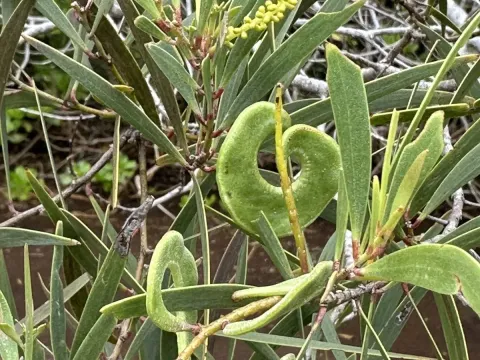
Acacia spirorbis
Acacia spirorbis
Acacia spirorbis seeds are best sown at the beginning of the rainy season to provide seedlings with adequate moisture during their establishment phase. Due to their hard seed coat, pre-sowing treatments such as scarification or brief immersion in hot water are essential to ensure high germination rates.
What the section contains
Acacia spirorbis
In nursery settings, container-grown seedlings are preferred to maintain root integrity. This method significantly increases survival rates when plants are eventually moved to the field, especially in harsh or degraded terrain where root establishment is challenging.
Field planting density typically ranges between 2,500 and 3,000 trees per hectare, depending on the management objectives. Proper spacing ensures that crowns close quickly, creating a canopy that suppresses weeds and reduces the need for manual or chemical maintenance.
During the first year, seedlings require protection from excessive competition by grasses. Manual weeding around the base of the plant is recommended to ensure that the acacia receives enough nutrients and water during its most vulnerable developmental stage.
Hardening off the seedlings before field transplantation is a critical step in the agricultural process. Gradually reducing irrigation and exposing plants to full sunlight for a few weeks ensures they are resilient enough to survive in open, exposed environments.
Acacia spirorbis is a woody legume species native to the tropical regions of the South Pacific, including New Caledonia and Vanuatu. It is highly valued for its exceptional ability to thrive on poor, rocky, and saline soils where few other timber trees can survive.
The tree requires full sun exposure for optimal growth and development. Shaded environments inhibit its vertical growth and result in sparse foliage, so careful site selection is mandatory for high-yield timber production and effective reforestation.
Climatic requirements are centered around stable, warm tropical conditions. The species exhibits remarkable drought resistance, as its root system is capable of exploring deep soil layers to find water even during prolonged dry spells.
As a nitrogen-fixing legume, Acacia spirorbis plays a vital role in soil enrichment. It naturally enhances soil fertility by converting atmospheric nitrogen into a form available to plants, making it an excellent candidate for land reclamation and agroforestry.
The tree is well-adapted to windy environments, which, combined with its strong wood, makes it highly suitable for windbreaks. Its robust roots help stabilize topsoil, significantly mitigating soil erosion in hilly, vulnerable areas.
The primary economic output of Acacia spirorbis is its dense, durable, and rot-resistant timber. It is frequently harvested for high-quality firewood, charcoal production, and fence posts due to its exceptional longevity and structural stability.
Rotation cycles for timber production vary depending on soil quality and climatic conditions but generally range from 15 to 25 years. With proper silvicultural management, including pruning, the tree can produce high-value logs suitable for furniture making.
Beyond timber, the species contributes to agricultural yield by improving the conditions of neighboring crops in agroforestry systems. The leaf litter provides a steady supply of organic matter that enriches the surrounding soil profile.
In terms of biomass production, the species is considered highly productive. It can rapidly accumulate wood volume, which is essential for sustainable fuelwood plantations, a key energy source for many tropical rural communities.
The potential for honey production is another secondary benefit, as the tree produces blossoms that attract pollinators. This integrated approach allows landowners to obtain multiple products from a single plantation, enhancing overall farm profitability.
Root rot is the most significant disease risk, typically triggered by waterlogged conditions. Ensuring that plantation sites have excellent natural drainage is the most effective preventative measure against this fungal threat.
Defoliating insects can occasionally cause damage to young saplings, though they rarely pose a threat to mature trees. In most cases, natural predators and regular monitoring are sufficient to keep pest populations at manageable levels.
Wood-boring beetles may target stressed or damaged trees. Maintaining the vigor of the plantation through proper spacing and regular sanitation—such as removing dead branches—helps to reduce the attractiveness of the stand to these pests.
Mechanical damage to the bark caused by heavy machinery or poor pruning techniques creates entry points for pathogens. Careful handling and the use of sharp, sanitized tools during silvicultural interventions are essential practices.
Overall, Acacia spirorbis is a robust species with a low profile for major epidemics. Its high natural resistance, when paired with good site management, minimizes the need for chemical interventions, making it a sustainable choice for forestry.