
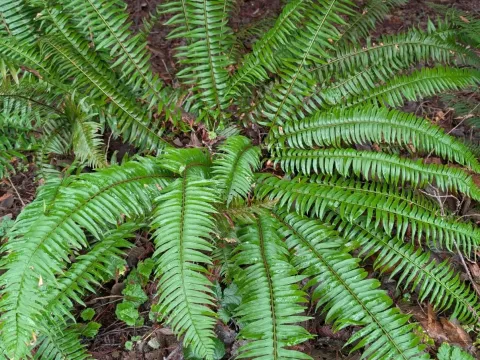
Shield fern
Polystichum
The Polystichum genus, commonly known as shield fern, belongs to the Dryopteridaceae family. These perennial ferns are highly regarded in horticulture for their evergreen or semi-evergreen habit and robust, leathery fronds that add structure to shade gardens.
What the section contains
 Braun's holly fern
Polystichum braunii
Braun's holly fern
Polystichum braunii
 Christmas fern
Polystichum acrostichoides
Christmas fern
Polystichum acrostichoides
 Hard shield fern
Polystichum aculeatum
Hard shield fern
Polystichum aculeatum
 Hooker's holly fern
Polystichum hookerianum
Hooker's holly fern
Polystichum hookerianum
 Long-lobed holly fern
Polystichum neolobatum
Long-lobed holly fern
Polystichum neolobatum
 Mother shield fern
Polystichum proliferum
Mother shield fern
Polystichum proliferum
 New Zealand shield fern
Polystichum neozelandicum
New Zealand shield fern
Polystichum neozelandicum
 Northern holly fern
Polystichum lonchitis
Northern holly fern
Polystichum lonchitis
 Polystichum basipinnatum
Polystichum basipinnatum
Polystichum basipinnatum
 Polystichum biaristatum
Polystichum biaristatum
Polystichum biaristatum
 Polystichum craspedosorum
Polystichum craspedosorum
Polystichum craspedosorum
 Polystichum drepanum
Polystichum drepanum
Polystichum drepanum
 Polystichum hybrids
Polystichum hybrids
Polystichum hybrids
 Polystichum luctuosum
Polystichum luctuosum
Polystichum luctuosum
 Polystichum makinoi
Polystichum makinoi
Polystichum makinoi
 Polystichum tripteron
Polystichum tripteron
Polystichum tripteron
 Prickly shield fern
Polystichum vestitum
Prickly shield fern
Polystichum vestitum
 Rigid shield fern
Polystichum rigens
Rigid shield fern
Polystichum rigens
 Scaly-stemmed holly fern
Polystichum lepidocaulon
Scaly-stemmed holly fern
Polystichum lepidocaulon
 Sickle-leaved shield fern
Polystichum falcinellum
Sickle-leaved shield fern
Polystichum falcinellum
 Tassel fern
Polystichum polyblepharum
Tassel fern
Polystichum polyblepharum
 Western sword fern
Polystichum munitum
Woronow's shield fern
Polystichum woronowii
Western sword fern
Polystichum munitum
Woronow's shield fern
Polystichum woronowii
 Yunnan shield fern
Polystichum yunnanense
Yunnan shield fern
Polystichum yunnanense
Shield fern
Native to various temperate and subtropical regions across the globe, these plants have adapted to thrive in cool, moist environments. In a garden setting, they prefer sheltered spots protected from harsh winds and direct afternoon sunlight, which can scorch their delicate foliage.
Success in cultivation requires well-draining, humus-rich soil with a neutral to slightly acidic pH. The root system must remain moist but never waterlogged; therefore, ensuring proper drainage or incorporating organic matter into the soil is a fundamental agricultural practice.
Maintenance involves routine watering during dry spells and applying a mulch layer of compost or shredded leaves in late autumn. This practice not only retains moisture but also mimics the natural forest floor conditions these ferns require for optimal growth.
Commercially and ornamentally, the shield fern is utilized as an essential groundcover for shaded areas, rock gardens, and woodland landscapes, valued for its long-lived nature and low maintenance requirements.
Common pathological issues include various types of root rot caused by poor soil drainage and stagnant water. Additionally, leaf spot diseases can occur if the foliage is kept excessively wet in conditions with limited airflow.
Primary pests include slugs and snails that target young, unfurling fronds, as well as scale insects or foliar nematodes which, if left untreated, can lead to significant aesthetic damage and reduced plant vigor.