

Monilia blight
Monilinia laxa
Description
Symptoms
The primary symptom is the rapid wilting and browning of blossoms and young leaves, which look as if they have been scorched by fire.
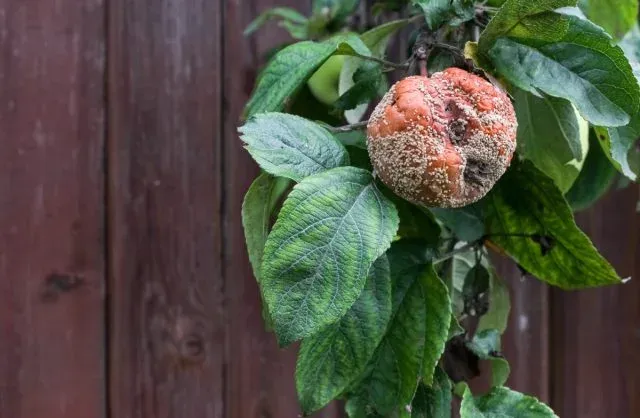
In fruits, infection manifests as small, circular brown spots that expand rapidly until the entire fruit is decayed, often remaining firm initially.
Dense, buff-colored, or gray spore cushions (pustules) develop on the surface of decaying fruits, often arranged in concentric circles.
Infected fruits frequently shrivel and mummify, becoming hard, black, and leathery; these mummies remain attached to the tree throughout the winter.
- Sudden wilting of floral clusters.
- Appearance of gray fungal mats on fruit.
- Mummification of infected fruit.
- Cankers and wood necrosis on twigs and branches.
Pathogen
The disease is caused by the fungus Monilinia laxa (anamorph Monilia cinerea), a member of the Sclerotiniaceae family. It is responsible for both blossom wilt in spring and brown rot in ripening fruits.
The fungus overwinters as mycelium in infected twigs, spurs, and mummified fruits attached to the branches or fallen on the ground. When conditions are favourable, it produces conidia spread by wind, rain, and insects.
The host range is extensive, including stone and pome fruits: apple, pear, cherry, sour cherry, apricot, peach, and almond.
The life cycle of M. laxa is closely tied to host phenology, with the fungus typically invading blossoms first and then colonizing fruit and woody tissues.
It secretes toxic metabolites that kill plant tissues, leading to the characteristic wilting and necrosis of branches commonly known as blossom wilt.
Conditions for development
Cool, wet weather during the blossoming period (15–20 °C) is the most critical factor for the primary infection of blossoms and spurs.
Fruit rot is favoured by high humidity and rain during the maturation period, especially when fruits are approaching harvest time.
Poor orchard sanitation, such as leaving mummified fruits on trees or the ground, creates a massive reservoir of inoculum for subsequent seasons.
Dense, unpruned tree canopies trap moisture and humidity, providing the ideal microclimate for fungal spore germination and colonization.
Any mechanical damage to fruit skin, often caused by hail, wind, or pest activity, facilitates the rapid entry of fungal hyphae.
Why it matters
Monilia blight is highly destructive, capable of causing significant yield losses, sometimes exceeding 50% of the annual harvest.
The blossom wilt phase can lead to extensive dieback of fruit-bearing wood, severely reducing the tree's productive potential for years to come.
Fruit rot renders the crop unsellable and inedible, as the pathogen causes rapid tissue breakdown and toxin production within the pulp.
The presence of M. laxa complicates export and storage operations, as infected fruits can easily contaminate healthy batches during transport.
Chronic infections weaken the tree's overall vigor, making it more susceptible to environmental stress and secondary pathogen infestations.
Protection
Sanitation is the cornerstone of management: prune out infected twigs and remove all mummified fruits to reduce the primary inoculum load.
Pruning to open the tree canopy improves air circulation and sunlight penetration, which helps keep the foliage and fruit dry.
Protective fungicide applications at the 'pink bud' stage, during full bloom, and at petal fall are essential to prevent blossom infection.
Copper-based sprays applied during dormancy (late autumn or early spring) are effective for suppressing overwintering fungal structures on the bark.
Integrate pest management (IPM) to control insects that wound fruit, as preventing mechanical damage significantly reduces the incidence of brown rot.
In brief
15
Affects crops
Biology
Pathogens and affected parts
Pathogens
Monilinia laxa· fungus
Monilinia fructicola· fungus
Monilia· fungus
Monilinia fructigena· fungus
Monilia fructigena· fungus
Monilinia mali· fungus
Monilinia azaleae· fungus
Monilinia vaccinii-corymbosi· fungus
Monilia vaccinii-corymbosi· fungus
Moniliophthora roreri· fungus
Monilinia oxycocci· fungus
Monilinia urnula· fungus
Affected plant parts
whole plantfruitleafstemroot
Content graph
Affects crops · 15
Content graph
Connections · Monilia blight
Most often together:
Marketplace
Products · 353






Community
Discussion
No discussions yet — be the first.