


SKU #4045
·
698 views
Apricot Academic
Apricot
Purpose
Universal
Flavor
Sour-sweet
Pit
Easily removable
Fruit Color
Orange
Your mark
0 votes
0% positive ratings
Store offers · 15 from 5 stores
15 offers in 5 stores — from 2.97 € per seedling.
Available at: AgronomVIP · Крымский Фрукт · Сад-виноград Рівненщини · Интернет магазин садовых растений Все Сорта · Agromir
Prices are collected automatically from store websites and converted at the current exchange rate. Check the price and availability on the store website before ordering.
Description
The variety was obtained by G.T. Kazymyin and V.A. Marusich through interspecific crossbreeding of the varieties 'Sputnik' and 'Khabarovsk' at DalNIISKh. The variety was introduced into the State Register in 1996 for the Far Eastern region.
The tree is strongly growing, forming an oval-elongated crown. The trunk is of medium thickness. The bark on the trunk is rough and gray, while on first- and second-order branches it is pale gray. One-year-old shoots are slightly curved, greenish-brown with numerous subcutaneous dots. Buds are large, usually occur in groups of three, set apart from the shoots, light brown. Leaves are large, egg-shaped, slightly pointed at the apex, thin and smooth. The upper side of the leaf is dark green, the lower side is whitish. The petiole is dark green with a slight reddish tint, long. The flower is large, pale pink, with a short greenish pedicel. Petals are moderately closed, egg-shaped. The calyx is cup-shaped. The style of the pistil is located above or at the same level as the stamens, making the variety partially self-fertile. High yields are produced in mixed plantings with the varieties 'Khabarovsk' and 'Amur'.
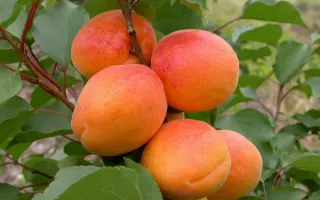
Fruits are large, weighing from 32 to 55 g. Their shape is oval-elongated with a beak at the apex. The surface is slightly hairy, smooth, orange with a carmine blush. They do not crack under rain. The flesh is light yellow, juicy, tender, slightly crunchy, with a pleasant sweet-tart flavor. Sugar content in the fruit is 11.8%, malic acid 2.3%, dry matter 16.6%. The taste rating of the fruit is 4 points. Transportability is average. The pit detaches easily. The pit is medium-sized, oval-flat in shape, with a distinct ridge. The kernel is sweet.
Flowering occurs on average between May 15-25. Fruit ripening occurs at the end of July to the beginning of August. Fruit production begins on the third year of the graft, mass production on the sixth to seventh year. The tree bears fruit annually. Yield over six years is 111.5 kg per tree (1990: 9.4 kg, 1991: 22.8 kg, 1992: 15.2 kg, 1993: 13.4 kg, 1994: 14.5 kg, 1995: 36.6 kg). Cold and drought resistance is relatively high when grown on mountain slopes. On islands and riverbank valleys, the tree freezes. To improve resistance, grafting onto highly cold- and drought-resistant scaffold branches is recommended. It is relatively resistant to drought and waterlogging on the surface of the bed. Moderately resistant to moniliosis, clasterosporiosis, and fruit rot. Moderately damaged by fruit borers.
Advantages of the variety: large fruits of universal type, good commercial appearance (retain their flavor and appearance for a week). Fruits do not crack. This is the largest-fruited local variety.
Disadvantages of the variety: weak winter hardiness in lowlands, susceptible to scorching on moist soils.
Video · 5 videos
Suggest a video →Crop & resistance
Crop
Disease resistance
Specifications
| Purpose | |
|---|---|
| Flavor | |
| Pit | |
| Fruit Color | |
| Yield | 111.5 |
| Self-fertility | |
| Disease Resistance | |
| Transportability | |
| Zoning | |
| Features | |
| Catalog | Catalog → Apricot |
No reviews yet. Be the first to share your experience.
Alternatives
Apricot saplings · similar varieties





See also
Often considered together with this variety


Recently viewed
Products you’ve viewed on this site
Reviews