


SKU #4160
·
1 289 views
Cherry plum Gift to Saint Petersburg
Cherry Plum
Purpose
Universal
Ripening Period
Mid-season
Flavor
Sour-sweet (sugar 8–11%)
Fruit Color
Orange
Your mark
1 vote
0% positive ratings
Store offers · 15 from 11 stores
15 offers in 11 stores — from 6.37 € per seedling.
Available at: 1sad · AgronomVIP · АСТ Медовое · biolocus-plant-pro · irkutsk-legendi-rastenii-ru · moscow-garden24-ru · plodovyimir-ru · Sadovnik-sam · vihervimma-fi · Все для сада · Интернет магазин садовых растений Все Сорта
Prices are collected automatically from store websites and converted at the current exchange rate. Check the price and availability on the store website before ordering.
Description
Hybrid peach variety derived from Chinese plum and the peach variety 'Pionerka'. Pollination was conducted at the Crimean Experimental Selection Station of VIR in Krymsk, Krasnodar region. Seedling cultivation, study, and selection were carried out at the Pavlovsk Experimental Station of VNIIR named after N.I. Vavilov in Saint Petersburg. Breeders are V.L. Vitkovsky, G.V. Yeremin, Z.M. Gavrilina, O.E. Radchenko. Approved for the Northwest region of Russia in 1999.
Tree is weak- or medium-growing with a wide, spreading, dense crown and short trunk. Leaves are elongated-oval, pointed at the apex, glossy, hairless, bright light green, strongly curved at the base into a boat shape, with wavy edges. Flowers and fruits form on flowering branches and vegetative shoots. One bud produces 2-4 flowers. Buds and petals are white, corolla small, 16 mm in diameter, saucer-shaped. Petals are small, broadly oval, with wavy edges. Few stamens — 15, filaments straight, 7 mm long, yellow anthers. Stigma is slightly curved, ovate, positioned above the anthers. Calyx is cup-shaped, with oval sepals, slightly hairy on the inner side.
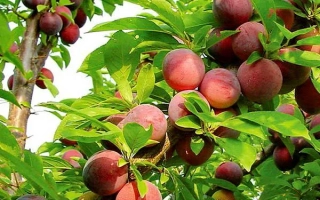
Fruits weigh 12 g, elongated-oval, slightly pointed apex, weakly noticeable ventral suture, bright yellow-orange, with a delicate aroma. Skin is thin, elastic, with slight waxy coating and light-yellow subcutaneous spots. Flesh is bright yellow, juicy, fine-fibrous, with harmonious sour-sweet taste. Fruits contain 16% dry matter, 8% sugars, 2.9% free acids, 12 mg/100g ascorbic acid, 0.76% pectins, 1065 mg/100g bioflavonoids, 1.7 mg/100g carotenoids. Stone weighs 0.8 g, oval-rounded, smooth, pointed apex, constitutes 5.5% of fruit mass, poorly separates from flesh. Variety is universal-purpose, fruits have excellent dessert and canning qualities.
Plants begin fruiting in the 3rd year after grafting. Flowering occurs early — May 6-21, fruit ripening is medium-early — August 8-28. Best pollinators are varieties 'Pavlovskaya Zhyeltyaya' and 'Pchel'nikovskaya'.
Variety exhibits regular fruiting, at 10 years of age yields on average 27 kg per tree, up to 60 kg. Besides stable high yield, notable advantages include good winter hardiness and excellent vegetative recovery ability after mechanical damage. Under significant temperature fluctuations at the end of winter and early spring, flower buds suffer frost damage. In experiments with artificial freezing of one-year shoots in mid-February to -28ºC, 55% of flower buds died, and at -35ºC, 95% died. Bark and wood tissues of shoot tips were damaged by 1 point. Under natural conditions, in epiphytotic years, fruits are affected by moniliosis up to 2 points, leaves by clasterosporiosis up to 1 point, and aphids and winter moth up to 1 point.
Drawbacks of the variety: flower buds are damaged by significant early spring temperature fluctuations, self-incompatible, fruits may drop off when fully ripe.
Video · 7 videos
Suggest a video →Crop & resistance
Crop
Disease resistance
Pest resistance
Specifications
| Purpose | |
|---|---|
| Ripening Period | |
| Flavor | |
| Fruit Color | |
| Fruit Weight | 12 |
| Yield (kg/tree) | 27-60 |
| Pollinator | |
| Catalog | Catalog → Cherry Plum |
No reviews yet. Be the first to share your experience.
Alternatives
Cherry Plum · similar varieties


See also
Often considered together with this variety




Recently viewed
Products you’ve viewed on this site
Reviews