

Description
How to identify
The winter moth (Operophtera brumata) is a member of the Geometridae family. It is a common pest that exhibits significant sexual dimorphism in its adult stage.
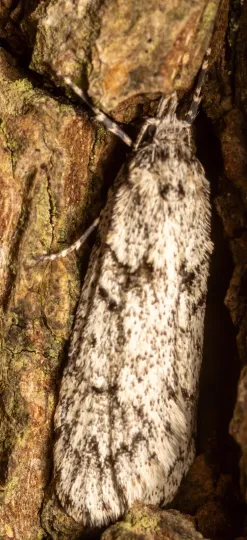
Males are typical moths with a wingspan of about 30–35 mm, featuring brownish-grey wings with darker transverse bands. They are active flyers and are often attracted to artificial lights in late autumn.
Females, in contrast, have vestigial, flightless wings and are unable to fly. They look more like small, elongated insects that must crawl up tree trunks to reach the canopy.
The larvae are known as inchworms or loopers due to their unique method of locomotion, where they arch their body to move from one point to another.
Fully grown caterpillars are about 20–25 mm long, light green in color, with a characteristic dark line running down their back and white lateral stripes.
What it damages
Winter moths are highly polyphagous and attack a wide range of fruit trees, including apples, pears, cherries, and plums, as well as many hardwood forest trees.
The primary damage is caused by larvae feeding on developing buds, blossoms, and young leaves, which can lead to complete defoliation of the tree.
In cases of severe infestation, the loss of blossoms results in a catastrophic reduction in fruit production, as the caterpillars destroy the reproductive organs.
The larvae are capable of skeletonizing foliage, leaving only the primary veins of the leaves, which significantly weakens the tree's health and photosynthetic capacity.
Young trees in nurseries or newly planted orchards are particularly vulnerable, as repeated defoliation can stunt their growth or even cause tree death.
When it appears
The life cycle of the winter moth is univoltine, meaning there is only one generation per year, with adults emerging in late autumn, typically October and November.
After mating, females lay eggs in crevices of the tree bark or near the buds, where the eggs remain dormant throughout the winter season.
Eggs hatch in early spring, precisely matching the time when tree buds begin to swell and open, providing the emerging larvae with immediate high-quality food.
Larval development takes about a month. Once fully fed, the caterpillars descend to the soil, where they create a pupal chamber to undergo metamorphosis.
The insects spend the entire summer as pupae in the top layer of the soil under the canopy, waiting for the temperature to drop in autumn to emerge as adults.
Signs of infestation
One of the earliest signs of infestation is the presence of silk webbing on the ends of branches, used by larvae to pull leaves together for protection.
Damaged, withered, or partially eaten buds are clear indicators of early larval feeding activity during the spring leaf-out period.
Evidence of frass (caterpillar droppings) accumulating around the base of buds or on the leaves is a strong indicator of an active population in the canopy.
The presence of flightless females crawling up the tree trunks in late autumn is a diagnostic sign of the upcoming generation of larvae.
Visible skeletonization of leaves, where only the tough leaf skeleton remains, confirms an established and potentially damaging population density.
Control measures
Sticky bands applied around tree trunks in early autumn prevent the flightless females from climbing into the canopy, effectively stopping egg-laying.
Cultivating the soil beneath the trees in late summer or early autumn can disrupt the pupal chambers and reduce the number of insects that survive to adulthood.
If chemical control is necessary, apply insecticides during the early stages of bud burst when the larvae are small and most susceptible to treatment.
Biological control methods, such as encouraging natural predators like insectivorous birds or parasitic wasps, help maintain a natural balance in the orchard.
The use of biological pesticides based on Bacillus thuringiensis is an effective and environmentally friendly way to manage the larvae without harming beneficial pollinators.
Content graph
Connections · Winter moth
Most often together:
Marketplace
Products · 7


Biology
Taxonomy
- Latin name
- Chimabache
- Order
- Lepidoptera (butterflies)
- Family
- Chimabachidae
- EPPO code
- CHIBSP
Community
Discussion
No discussions yet — be the first.