


SKU #4088
·
846 views
Khabarovskiy
Apricot
User rating
0 votes0% positive reviews
No ratings yet — be the first.
Assignment
For Fresh Consumption
Ripening Period
28-30
Flavor
Sour-sweet
Core
Easily removable
Store offers · 1 from 1 stores
Prices are updated on loadLoading offers…
Available at: Азбука сада · Царь Сад
Aggregator catalog: prices are collected automatically from store websites, normalized by AI and converted at the current exchange rate. Before ordering, confirm the price and availability on the store's website. This block is not indexed by search engines — the data is loaded after the page opens.
About product

The variety was obtained by G.T. Kazymin at DalNIISKh in 1949 from pollination of the 'Luchshiy Michurinskiy' variety with pollen from the European variety 'Krasnochekiy'. It has been approved for cultivation in Primorsky and Khabarovsk (southern) regions. The tree is vigorous, reaching large dimensions. At age 10, its height is 4.8 m and width 5.1 m. The crown is sparse and spreading. Main branc…
Assignment
For Fresh Consumption
Ripening Period
28-30
Flavor
Sour-sweet
Core
Easily removable
Description
The variety was obtained by G.T. Kazymin at DalNIISKh in 1949 from pollination of the 'Luchshiy Michurinskiy' variety with pollen from the European variety 'Krasnochekiy'. It has been approved for cultivation in Primorsky and Khabarovsk (southern) regions.
The tree is vigorous, reaching large dimensions. At age 10, its height is 4.8 m and width 5.1 m. The crown is sparse and spreading. Main branches are thick, straight, dark-purple, with numerous whitish longitudinal stripes. One-year shoots are thick, straight, and long, reaching 1 meter on young trees. Fruit set occurs usually on two- or three-year-old wood as long or short fruiting spurs, symmetrically positioned at right angles to the main branch. Fruit buds are large, rounded-acute in shape, arranged singly or in pairs or trios: lateral fruit buds, central growth buds. Leaves are of medium size, elongated-oval, with a sharp long apex. Leaf blade is dark green on the upper side, matte, light green on the underside. Petiole is long, burgundy-red. Leaf margin is serrated. Flowers are large, white. Petal shape is round. Petal closeness is weak. Stigma is usually at the same level as stamens, making the variety relatively self-fertile. No flower damage from cold occurred.
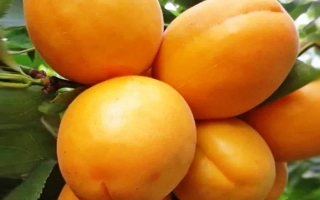
Fruits are large, average weight 30 g, maximum 45 g. Shape is rounded-conical, slightly compressed laterally. Fruit apex is pointed, basal cavity deep. Suture is wide and deep. Fruit surface is bumpy, heavily hairy, skin does not peel off. Color is pale green, covered with a continuous or occasionally punctate orange-red blush. Flesh is dense, medium juicy, yellow-orange in color, pleasant sweet-sour flavor. Fruits contain 12.3% sugars, 2.1% malic acid, 7.9% vitamin C, 16.1% dry matter. Based on taste quality, the variety is intended for table use. Fruit transportability is moderate. Sensory evaluation of fruits is 4 points. Stone weight is 1.2 g, oval-rounded, with ridges, easily separates from flesh. Kernel is sweet.
Trees begin fruiting on the 4th or 5th year after grafting. The variety is capable of annual, stable fruiting. Fruits ripen July 28–30. Maximum yield per tree is 36.6 kg.
The variety is drought- and waterlogged-tolerant. Moderately resistant to moniliosis and clasterosporiosis. Lightly damaged by fruit moth. Has satisfactory winter hardiness. To improve winter hardiness, it is propagated by grafting onto high-winter-hardy rootstocks or by layering with winter protection.
Advantages of the variety: large, table-usable fruits of good commercial appearance, high annual yield. Stone with sweet kernel. Widely used for propagation by seed.
Disadvantages: weak winter hardiness in low-lying areas, insufficient fruit transportability.
Video · 5 videos
Suggest a video →Crop & resistance
Crop
Disease resistance
Specifications hover over for a hint about the specification
| Assignment | |
|---|---|
|
Ripening Period
Ripening Period
It takes 70-100 days until pepper reaches flowering stage, 130-160 days until technical fruit ripeness, and 135-180 days until physiological ripeness. |
28-30 |
| Flavor | |
| Core | |
| Tree Height | 4.8 |
|
Yield
Yield
Overall bulb harvest per unit area. Depends on both onion variety characteristics and agronomic practices, fertilizers, and irrigation. Under optimal growing conditions, an onion yield of 100 tons per hectare and above is not considered record-breaking. |
36.6 |
| Self-fertility | |
| Disease Resistance | |
| Transportability | |
| Zoning | |
| Features | |
| Catalog | Catalog → Apricot |
Not yet комментариев. Be the first!
Alternatives
Apricot saplings · similar varieties




See also
Often considered together with this variety




Recently viewed
Products you’ve viewed on this site
Reviews · 0