
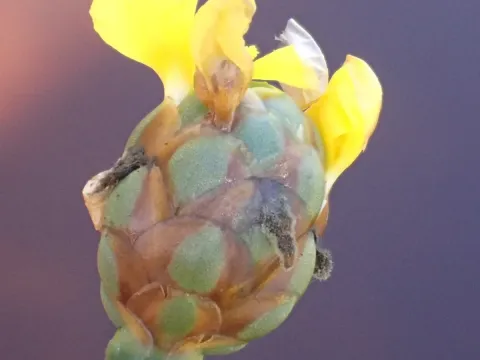
Xyris
Xyris
The genus Xyris, commonly known as yellow-eyed grass, belongs to the family Xyridaceae. These monocotyledonous plants are predominantly found in wet, acidic habitats throughout the tropical and subtropical regions of the world, although some species inhabit temperate zones.
What the section contains
 Baldwin's yellow-eyed grass
Xyris baldwiniana
Baldwin's yellow-eyed grass
Xyris baldwiniana
 Carolina yelloweyed grass
Xyris caroliniana
Carolina yelloweyed grass
Xyris caroliniana
 Drummond's yellow-eyed grass
Xyris drummondii
Drummond's yellow-eyed grass
Xyris drummondii
 Elliott's yelloweyed grass
Xyris elliottii
Elliott's yelloweyed grass
Xyris elliottii
 Fan-leaved yellow-eyed grass
Xyris flabelliformis
Fan-leaved yellow-eyed grass
Xyris flabelliformis
 Florida yelloweyed grass
Xyris floridana
Florida yelloweyed grass
Xyris floridana
 Indian yellow-eyed grass
Xyris indica
Indian yellow-eyed grass
Xyris indica
 Northern yellow-eyed grass
Xyris montana
Northern yellow-eyed grass
Xyris montana
 Rough-leaved yellow-eyed grass
Xyris scabrifolia
Rough-leaved yellow-eyed grass
Xyris scabrifolia
 Shortleaf yellow-eyed grass
Xyris brevifolia
Shortleaf yellow-eyed grass
Xyris brevifolia
 Tennessee yellow-eyed grass
Xyris tennesseensis
Twisted yellow-eyed grass
Xyris torta
Tennessee yellow-eyed grass
Xyris tennesseensis
Twisted yellow-eyed grass
Xyris torta
 Xyris ambigua
Xyris barteri
Xyris barteri
Xyris ambigua
Xyris ambigua
Xyris barteri
Xyris barteri
 Xyris capensis
Xyris capensis
Xyris capensis
 Xyris complanata
Xyris complanata
Xyris complanata
 Xyris difformis
Xyris difformis
Xyris difformis
 Xyris fimbriata
Xyris isoetifolia
Xyris isoetifolia
Xyris fimbriata
Xyris fimbriata
Xyris isoetifolia
Xyris isoetifolia
 Xyris juncea
Xyris juncea
Xyris juncea
 Xyris jupicai
Xyris jupicai
Xyris jupicai
 Xyris longisepala
Xyris longisepala
Xyris longisepala
 Xyris melanocephala
Xyris savanensis
Xyris savanensis
Xyris melanocephala
Xyris melanocephala
Xyris savanensis
Xyris savanensis
 Xyris serotina
Xyris serotina
Xyris serotina
 Xyris smalliana
Xyris smalliana
Xyris smalliana
 Xyris stricta
Xyris stricta
Xyris stricta
 Yellow-eyed grass
Xyris laxifolia
Yellow-eyed grass
Xyris laxifolia
 Yellow-eyed grass
Xyris platylepis
Yellow-eyed grass
Xyris platylepis
 Yellow-straw yellow-eyed grass
Xyris straminea
Yellow-straw yellow-eyed grass
Xyris straminea
Xyris
Botanically, Xyris species are characterized by their basal, grass-like leaves and solitary flowering stems that terminate in a head-like spike. The flowers are typically yellow and bloom for a short duration, reflecting the plant's adaptation to high-light environments and wetland moisture.
Successful cultivation of Xyris requires a very specific environment. The soil must remain consistently saturated and should be acidic in nature, often mimicking the boggy or peaty substrate found in its natural range. Drainage should be poor enough to maintain water retention.
While not a traditional industrial crop, Xyris is increasingly valued in environmental restoration projects and specialized landscape design, particularly for water gardens and constructed wetlands. Its ability to thrive in nutrient-poor, acidic conditions makes it a niche plant for sustainable landscapes.
Maintenance of these plants involves ensuring they are exposed to full sun exposure throughout the growing season. It is critical to monitor the pH level of the growing medium, as the plant will show signs of nutrient deficiency if the environment becomes alkaline.