
Shortleaf yellow-eyed grass
Xyris brevifolia
Description
Growing requirements
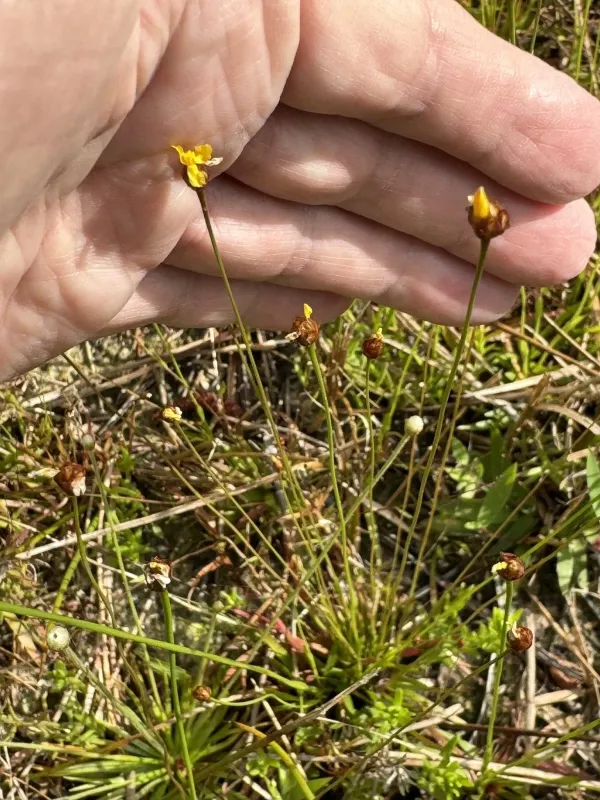
Shortleaf yellow-eyed grass (Xyris brevifolia) is a perennial herbaceous plant classified within the Xyridaceae family. Native to wetland environments, it thrives in environments characterized by saturated, acidic, and nutrient-poor soils, which are typical of bogs and pine barrens.
The plant requires high moisture levels and consistent light to maintain its structural integrity and reproductive health. In specialized cultivation, it is essential to replicate these hydrological conditions, avoiding the drying out of the root zone, which leads to rapid plant senescence.
Botanically, it features a tuft of narrow, grass-like leaves forming a basal rosette, from which distinct, stiff, and wiry scapes arise. The terminal inflorescence is a tight, cone-like spike, which is the hallmark diagnostic feature of the genus Xyris in the wild.
Agrotechnical management is minimal, focusing primarily on habitat preservation rather than intensive farming. It thrives in well-drained but permanently wet sandy soils, and it does not respond well to conventional commercial fertilizers, which can alter the delicate chemical balance of its substrate.
The utility of Xyris brevifolia is largely ornamental, particularly in bog gardens or specialized aquatic landscapes that mimic its natural habitat. While not a commercial crop in the traditional agricultural sense, it serves as an important bio-indicator for healthy wetland ecosystems.