
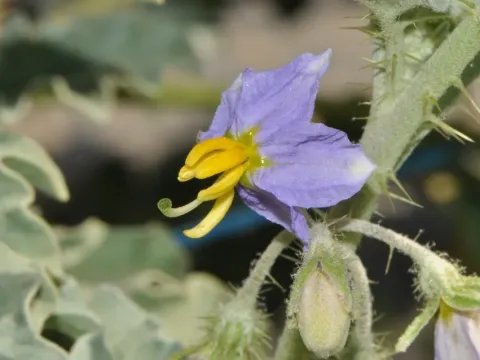
Solanum coagulans
Solanum coagulans
Solanum coagulans is a perennial herbaceous plant belonging to the Solanaceae family. This species is known for its remarkable adaptability to arid and semi-arid environments, making it a subject of interest for sustainable agricultural research in various regions.
What the section contains
Solanum coagulans
The plant thrives in well-drained soils, preferably sandy or loamy textures, with a neutral pH level. It requires high levels of solar radiation throughout the growing season and does not perform well in shaded or confined environments, as light is a critical factor for photosynthesis and yield.
Temperature requirements for this species are relatively high, with an optimal range between 22 and 30 degrees Celsius. It exhibits significant drought tolerance, which is facilitated by its unique root system architecture that allows for efficient moisture extraction from deep soil layers.
Water management is crucial during the early stages of establishment. Although the plant is hardy, providing regular, moderate irrigation during the initial vegetative phase ensures robust growth and canopy development before the plant reaches maturity.
Agronomic maintenance includes periodic weeding and inter-row cultivation to ensure soil aeration and reduce nutrient competition. The plant's slow initial development necessitates careful monitoring to prevent weeds from suppressing the crop during the first few weeks.
The economic value of Solanum coagulans is primarily linked to its biochemical profile. The fruits contain specific proteolytic enzymes that act as milk coagulants, a traditional property that has historical significance in various regional food processing applications.
Yield capacity is highly dependent on planting density and soil fertility. Typically, a density of 30,000 to 45,000 plants per hectare is recommended to optimize the vegetative biomass and the production of fruits containing the active enzymes.
The concentration of alkaloids and enzymes within the fruit is a critical quality factor. Ongoing research into the extraction of these bioactive compounds aims to standardize the quality of the raw material for industrial and laboratory use.
Harvesting efficiency is improved when plants are grown in structured, uniform rows, allowing for potential mechanization. Careful timing of the harvest is essential to ensure that the concentration of enzymes is at its peak based on fruit maturity stages.
Future development of this crop relies on selective breeding to decrease natural toxicity while enhancing the production of desired enzymes. Such advancements would turn this wild species into a more viable and commercially attractive agricultural resource.
Solanum coagulans is susceptible to typical Solanaceae pathogens, including late blight (Phytophthora infestans) and early blight (Alternaria solani). These diseases represent the greatest challenge in high-humidity environments where fungal proliferation is rapid.
Pest management is focused on controlling the Colorado potato beetle and various aphid species. These pests directly damage the leaf surface and stems, leading to severe vigor reduction and the potential transmission of mosaic viruses.
Preventative strategies are the cornerstone of disease control. Implementing a diverse crop rotation cycle, where the plant is not returned to the same plot for at least four years, is vital to break the life cycle of soil-borne pathogens.
Integrated pest management (IPM) practices, such as the use of biological control agents and selective chemical applications, are recommended to minimize damage. Monitoring programs should be in place to detect pests before they reach economic injury levels.
Sanitation practices, including the prompt removal of infected plant residues at the end of the season, are necessary to prevent the overwintering of pathogens in the field. Destroying infected material helps maintain a clean environment for subsequent planting cycles.