
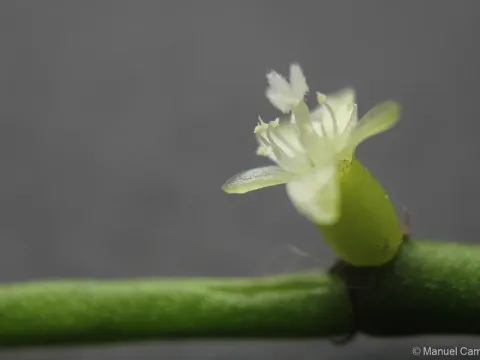
Rhipsalis
Rhipsalis Gaertn.
Rhipsalis is a diverse genus within the Cactaceae family, known for its epiphytic growth habit. Originating from the tropical rainforests of Central and South America, as well as parts of Africa, these plants naturally grow on trees and rocks, absorbing moisture and nutrients from the air and decaying debris.
What the section contains
 Mistletoe cactus
Rhipsalis baccifera (J. S. Muell.) Stearn subsp. baccifera
Rhipsalis baccifera
Rhipsalis baccifera (J. S. Muell.) Stearn
Mistletoe cactus
Rhipsalis baccifera (J. S. Muell.) Stearn subsp. baccifera
Rhipsalis baccifera
Rhipsalis baccifera (J. S. Muell.) Stearn
 Rhipsalis clavata
 F. A. C. Weber
Rhipsalis clavata
Rhipsalis clavata F. A. C. Weber
 Rhipsalis ewaldiana
 Barthlott & N. P. Taylor
Rhipsalis ewaldiana
Rhipsalis ewaldiana Barthlott & N. P. Taylor
 Rhipsalis lindbergiana
 K. Schum.
Rhipsalis lindbergiana
Rhipsalis lindbergiana K. Schum.
 Rhipsalis teres
 (Vell.) Steud.
Rhipsalis teres
Rhipsalis teres (Vell.) Steud.
Rhipsalis
The climate requirements for Rhipsalis are distinct from typical desert cacti. They thrive in warm, humid conditions with temperatures ranging between 18°C and 24°C. They do not tolerate frost and require protection from sudden temperature drops during the winter months.
Light management is crucial for the healthy development of this culture. Rhipsalis prefers bright, indirect light or filtered shade. Direct sunlight, especially in mid-summer, can scorch the delicate stems, leading to irreversible tissue damage and loss of plant vigor.
Soil requirements focus on high porosity and excellent drainage. A mix containing peat moss, pine bark, and coarse sand provides the necessary aeration for roots. Since they are epiphytes, they do not require deep soil layers and prefer a somewhat tight planting environment.
Consistent moisture is needed, but the substrate must never become waterlogged. Growers should aim for a moist but not soggy growing medium, allowing the top centimeter of the substrate to dry slightly before performing the next irrigation cycle.
Root rot is the most common threat, usually caused by overwatering or poor drainage systems. This condition often leads to the wilting of stems and the eventual collapse of the entire plant structure if not caught in time.
Mealybugs are a persistent pest that favors the protected areas between the succulent stem segments. These insects feed on the sap and can spread rapidly if the ambient humidity is too low for the plant's health.
Scale insects can also attach to the stem, appearing as hard, brownish bumps. They are difficult to remove manually and often require systemic insecticides or targeted applications of horticultural oil for effective control.
Spider mites are another challenge, particularly in indoor environments with poor air circulation. They cause fine webbing and yellowing of the segments, which detracts from the plant's ornamental value.
Preventative measures include maintaining good airflow, inspecting new plants for infestation before integrating them into the collection, and ensuring that water does not accumulate at the base of the stems, as this encourages fungal growth.