
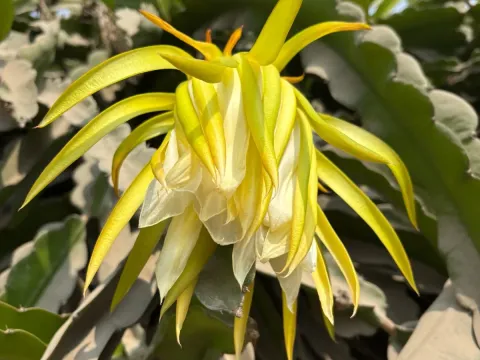
Selenicereus
Selenicereus
Propagation of Selenicereus is predominantly achieved through stem cuttings, ensuring the preservation of the plant's characteristic traits and growth habits.
What the section contains
 Costa Rican pitahaya
Selenicereus costaricensis (F. A. C. Weber) S. Arias & N. Korotkova
Costa Rican pitahaya
Selenicereus costaricensis (F. A. C. Weber) S. Arias & N. Korotkova
 Pitahaya hybrids
hybrids between Selenicereus guatemalensis and Selenicereus undatus
Pitahaya hybrids
hybrids between Selenicereus guatemalensis and Selenicereus undatus
 Pitaya
Selenicereus monacanthus (Lem.) D. R. Hunt
Pitaya
Selenicereus monacanthus (Lem.) D. R. Hunt
 Pitaya
Selenicereus undatus (Haw.) D. R. Hunt
Pitaya
Selenicereus undatus (Haw.) D. R. Hunt
 Queen of the night
Selenicereus grandiflorus (L.) Britton & Rose
Queen of the night
Selenicereus grandiflorus (L.) Britton & Rose
 Selenicereus guatemalensis
 (Eichlam ex Weing.) D. R. Hunt
Selenicereus guatemalensis
Selenicereus guatemalensis (Eichlam ex Weing.) D. R. Hunt
Selenicereus
The best time for harvesting cuttings is during the active growth phase, typically in spring, when the plant has sufficient energy reserves for root development.
Cuttings should be allowed to air-dry for several days until a callous forms, which is essential for preventing tissue decay when placed in the medium.
Planting requires a well-draining, slightly moist substrate, ensuring that the cuttings are held upright to encourage balanced root distribution.
Successful establishment is usually achieved within a few weeks, provided the temperature remains stable and the environment is protected from harsh conditions.
As an epiphytic genus, Selenicereus requires a growing medium that mimics its natural forest habitat, emphasizing high porosity and air circulation.
Optimal substrate composition includes a mix of pine bark, perlite, and organic peat to ensure adequate drainage and nutrient availability for the roots.
The culture thrives in temperatures ranging from 20°C to 28°C during the growing season and requires a cooler resting period in winter.
High levels of indirect sunlight are necessary for photosynthesis and the induction of flower buds, though protection from intense midday heat is advised.
Humidity management is crucial; regular misting mimics tropical conditions and supports the growth of healthy, succulent stems during the development cycle.
The productivity of Selenicereus is measured by its capacity to produce nocturnal, showy blooms and, under specific conditions, edible fruit.
Fruit set requires successful cross-pollination, which can be done manually to ensure a higher yield of mature, nutrient-dense cactus fruits.
Harvesting should occur when the fruit skin turns vibrant and yields slightly to pressure, indicating optimal sweetness and maturity.
Flower yield is heavily dependent on nutrient management, specifically the application of fertilizers high in potassium to promote reproductive growth.
Managing the plant's vertical growth through proper support systems is vital for maximizing the surface area exposed to light for improved total output.
Mealybugs are a persistent threat, often gathering in the crevices of the ribbed stems and sapping the plant's essential nutrients.
Spider mites are common in environments with low humidity, causing visible damage to the epidermis and potentially inhibiting photosynthesis.
Overwatering is the primary cause of root rot, a devastating condition that can compromise the plant's vascular system in a very short time.
Fungal pathogens often flourish in poorly ventilated spaces, leading to localized rotting or spotting on the fleshy stems of the cactus.
Integrated pest management strategies, including the use of neem oil or targeted acaricides, are recommended to maintain plant health and vigor.