
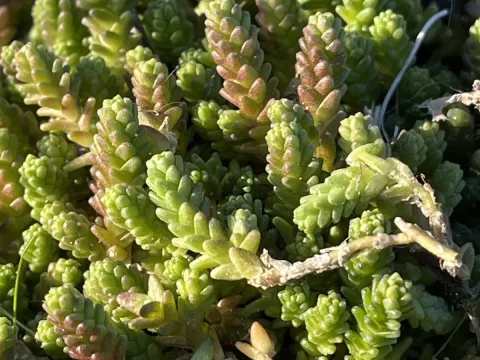
Sedum
Sedum L.
Sowing of Sedum seeds is primarily conducted in early spring, during March or April, using greenhouse or indoor seedling trays. The seeds are extremely small; therefore, they should be scattered over the surface of a moist substrate without being covered by soil, then kept under glass to maintain stable humidity.
What the section contains
 Burrito sedum
Sedum burrito Moran
Burrito sedum
Sedum burrito Moran
 Chinese stonecrop
Sedum tetractinum Fröd.
Chinese stonecrop
Sedum tetractinum Fröd.
 Donkey Tail
Sedum morganianum E. Walther
Donkey Tail
Sedum morganianum E. Walther
 Goldmoss stonecrop
Sedum acre L.
Goldmoss stonecrop
Sedum acre L.
 Japanese stonecrop
Sedum japonicum Siebold ex Miq.
Japanese stonecrop
Sedum japonicum Siebold ex Miq.
 Pork and Beans
Sedum x rubrotinctum R. T. Clausen
Pork and Beans
Sedum x rubrotinctum R. T. Clausen
 Rock stonecrop
Sedum rupestre L.
Rock stonecrop
Sedum rupestre L.
 Sedum adolphi
 Raym.-Hamet
Sedum adolphi
Sedum adolphi Raym.-Hamet
 Sedum lineare
 Thunb.
Sedum lineare
Sedum lineare Thunb.
 Sedum makinoi
 Maxim.
Sedum makinoi
Sedum makinoi Maxim.
 Sedum mendozae
 (Glass & Chazaro) V.V. Byalt
Sedum mendozae
Sedum mendozae (Glass & Chazaro) V.V. Byalt
 Sedum sarmentosum
 Bunge
Sedum sarmentosum
Sedum sarmentosum Bunge
 Sedum suaveolens
 Kimnach
Sedum suaveolens
Sedum suaveolens Kimnach
 Sedum versadense
 C.H. Thomps.
Sedum versadense x mendozae
Sedum versadense C.H. Thomps. x Sedum mendozae (Glass & Chazaro) V.V. Byalt
Sedum versadense
Sedum versadense C.H. Thomps.
Sedum versadense x mendozae
Sedum versadense C.H. Thomps. x Sedum mendozae (Glass & Chazaro) V.V. Byalt
 Thick-leaved stonecrop
Sedum dasyphyllum L.
Thick-leaved stonecrop
Sedum dasyphyllum L.
 White stonecrop
Sedum album L.
White stonecrop
Sedum album L.
Sedum
In commercial or ornamental production, vegetative propagation is considered more efficient. Cuttings are taken throughout the growing season, using stem or leaf sections that root quickly when placed in a light, well-draining potting mix.
For division of mature clumps, the procedure is planned for early spring or autumn. Plants are carefully lifted from the soil, and the rootstock is separated into multiple sections with viable growth points, which allows for the rapid establishment of large planting areas.
Transplanting seedlings into open ground is carried out once the danger of frost has passed. Sedum adapts well to new environments if air temperatures remain consistently above 15 degrees Celsius.
The planting pattern depends on the specific variety, typically ranging from 20 to 30 centimeters between plants. Planting density is adjusted based on whether the goal is to create a solid green carpet or to cultivate individual ornamental clumps.
Sedum belongs to the Crassulaceae family and is a classic succulent capable of storing water in its leaves. The plant is remarkably undemanding regarding soil conditions, preferring well-drained, sandy, or rocky soils with low fertility levels.
The culture is highly photophilous and requires open locations with direct sunlight for optimal development. When light is insufficient, Sedum stems become leggy, lose their turgor, and their specific leaf coloration fades, which decreases the overall quality of the crop.
The plant possesses high drought resistance and cannot tolerate excessive soil moisture, which leads to root system rot. Watering is only necessary during extreme drought; at other times, natural precipitation is usually sufficient for the plant's needs.
Regarding climate, Sedum is highly adaptable. Most varieties are frost-resistant and capable of overwintering without protection even in temperate climates. A critical requirement is the absence of standing water in spring during snowmelt, which can cause shoots to rot.
For fertilization, the use of mineral complexes with low nitrogen content is permitted. Excessive feeding stimulates vegetative mass at the expense of the plant's resistance to diseases and winter cold temperatures.
The primary threat to the culture is fungal infection, particularly root and stem rot caused by waterlogged substrates. Upon the first sign of infection, diseased parts must be removed, and the soil should be treated with appropriate fungicides.
Among pests, aphids and weevils cause the most damage by feeding on leaf sap and damaging young shoots. To control these insects, systemic insecticides or biological control agents are utilized if permitted by production standards.
Nematodes may attack the root system, causing stunted growth and deformation of the clumps. If nematode galls are detected, the affected plant must be destroyed immediately, followed by soil disinfection to prevent the spread of the pathogen throughout the site.
Slugs and snails often damage tender leaf blades, leaving characteristic trails and holes. To protect the crop during wet weather, mechanical barriers or baits are used to limit the movement of these gastropods near the planting beds.
Disease prevention consists of ensuring high-quality drainage and maintaining adequate spacing between clumps to allow for free air circulation. Constant monitoring of the leaf apparatus allows for mitigating threats at early stages of development.
Commercial use of Sedum includes the collection of medicinal raw material, harvested during the peak blooming period. Plants are cut several centimeters above the ground, taking care not to damage the rootstock to ensure regeneration in the following season.
Drying of the harvested material is performed in well-ventilated rooms or specialized dryers at temperatures not exceeding 45 degrees Celsius. It is crucial to maintain the integrity of the leaves and their natural structure, as they contain the bioactive compounds.
In landscaping, Sedum is rarely harvested or transplanted due to its status as a perennial. Maintenance involves periodic rejuvenation of clumps by removing old, woody stems, which stimulates the growth of fresh, young shoots.
For retail as potted crops, harvesting involves the careful transfer of plants into containers with prepared substrate. This process is carried out during the active growth phase so that the plant can re-establish roots before the dormancy period begins.
When grown for seeds, capsules are collected before they fully split. The material is dried in paper bags, after which the seeds are carefully shaken out and cleaned of debris before being stored in a dry place.