
Rose-colored houseleek
Sempervivum roseum
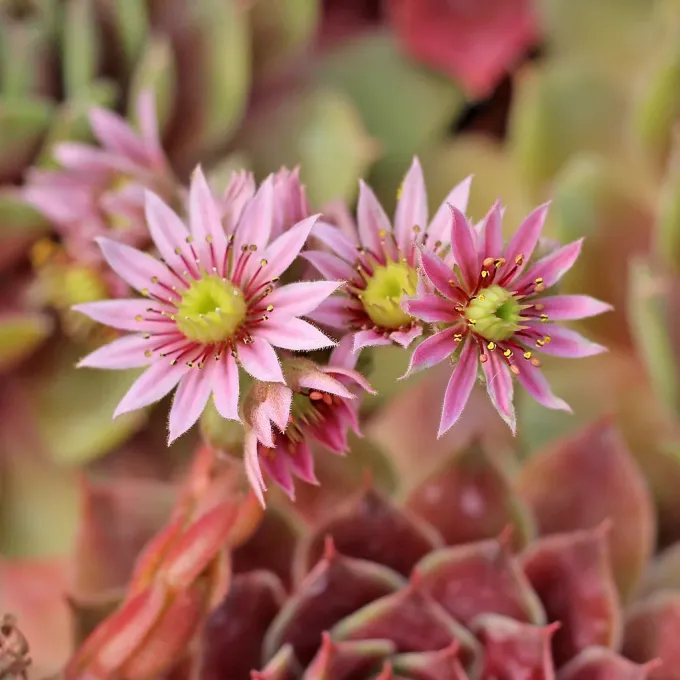
Description
Sowing dates
Propagation of the rose-colored houseleek is most commonly achieved vegetatively by using offsets (pups). The optimal time for separating and transplanting these rosettes is spring or early summer, when the plant is actively growing and expanding.
Seed propagation is practiced less frequently due to the small size of the seeds and the slow growth rate of seedlings. Sowing is conducted in late winter or early spring in a light, sandy substrate; seeds should be surface-sown and barely covered with fine sand.
Planting rosettes in their permanent location requires adequate spacing. To allow for full expansion, it is recommended to plant them at intervals of 10–15 centimeters, taking into account the natural rate of vegetative spread.
To speed up the rooting of pups, the soil around them should be kept lightly moist for the first two weeks. Once the plant has established its own root system, irrigation should be reduced to a minimum.
Planting during the autumn is not recommended, as young rosettes may not have sufficient time to adapt to lower temperatures and high humidity, which often results in root rot and decay.
Growing requirements
Rose-colored houseleek belongs to the Crassulaceae family and is a typical succulent adapted to high-altitude and rocky terrain conditions. It possesses high frost resistance and drought tolerance.
The crop requires sunny, open areas. In partial shade, rosettes lose their compact shape, become leggy, and their coloration becomes less vibrant, which reduces the plant's decorative and market value.
Soil requirements are minimal: the plant prefers lean, loose, and well-drained substrates. Heavy clay soils are unsuitable as moisture stagnation is fatal to the root system.
The plant thrives in neutral to slightly alkaline soils with a high content of sand or gravel. Adding lime to the substrate has a positive effect on the development of the root system.
A critical requirement is the absence of competition from weeds. Houseleek has low growth energy and is easily suppressed by more aggressive species, so regular weeding is essential.
Yield
The economic use of rose-colored houseleek is centered on ornamental horticulture, landscape design, and the creation of green roofs. Its economic efficiency is determined by the plant's ability to quickly cover surfaces with a dense mat.
The propagation coefficient is high: one parent rosette can produce between 5 and 10 daughter rosettes per season. This allows for rapid coverage of large areas during commercial cultivation.
The marketable unit is rooted rosettes, typically sold in trays or individual pots. There is a stable demand for this plant due to its low maintenance needs and its ability to remain decorative year-round.
The crop can be used as a living mulch layer, which reduces soil moisture evaporation and prevents erosion on slopes where other decorative crops might struggle to survive.
With intensive management practices, including timely division of the clumps, the yield of planting material per square meter can reach several hundred rosettes annually.
Main diseases and pests
The main threat to the houseleek is excessive moisture. If water stagnates in the soil or within the leaf rosettes, fungal diseases such as root rot and fusarium wilt develop, leading to rapid plant decline.
Among pests, root mealybugs and aphids pose the greatest danger. They extract sap from the succulent tissue, which causes stunted growth and deformation of the rosettes.
White grub larvae can damage the root system by feeding from below. This often goes unnoticed until the rosette detaches easily from the soil upon light contact.
- Root rot
- Powdery mildew (in overcrowded conditions)
- Aphids
- Slugs and snails
Disease prevention involves strict drainage control, avoiding excessive organic fertilization, and ensuring good air circulation between plants.
Harvesting
Harvesting houseleek for sale or transplanting is performed by lifting or separating rosettes. The process is labor-intensive and requires care to avoid damaging the succulent's fragile leaves.
For long-distance transportation, it is recommended to dry the rosettes for a few days. This helps heal micro-wounds at the separation points, preventing rot development during storage.
The optimal storage condition for harvested material is a cool, dry, and well-ventilated area. If the temperature is maintained between +5 and +10 degrees Celsius, rosettes can remain viable for several weeks.
Transportation is carried out in perforated containers to prevent crushing the rosettes. Airtight packaging must be avoided, as it causes a sharp rise in humidity and product spoilage.
During the harvest process, it is important to sort material by size and maturity, as this directly affects the final market price and the consumer's perception of quality.