
Donkey Tail
Sedum morganianum E. Walther
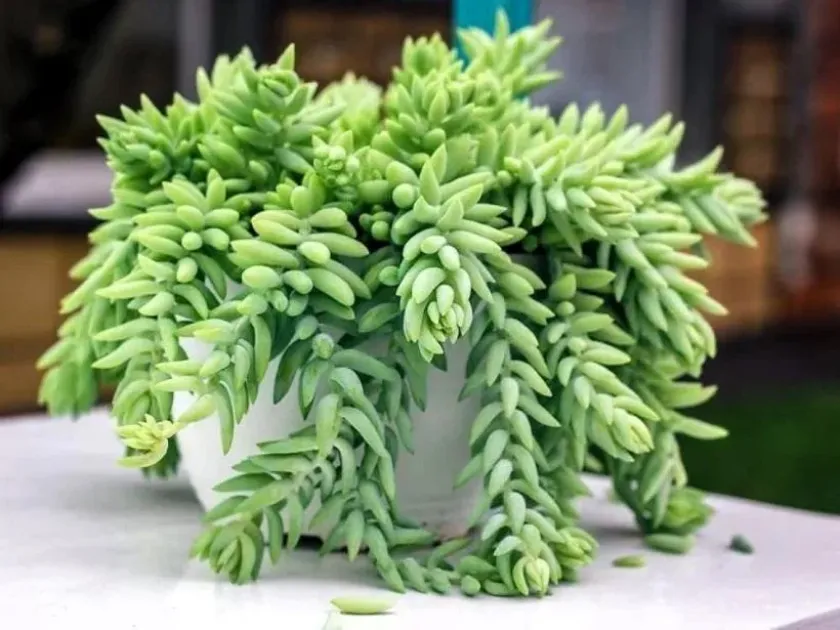
Description
Growing requirements
Sedum morganianum, commonly known as Donkey Tail or Burro's Tail, is a species of flowering plant in the family Crassulaceae. Originating from southern Mexico and Honduras, it has evolved as a succulent plant adapted to arid, rocky environments where drainage is excellent.
This species requires intense sunlight to maintain its structural integrity and leaf coloration. When kept indoors, it should be placed in the brightest spot available, preferably near a window that receives direct morning sunlight or very bright indirect light throughout the day.
The growing medium must be specifically formulated for succulents, characterized by high porosity and drainage. A standard mix usually includes volcanic rock, perlite, and coarse sand. Avoiding heavy soils is mandatory to ensure that the delicate root system does not remain damp.
Irrigation practices are centered on the soak-and-dry method. During the growing season, water thoroughly only when the substrate is completely dry. In winter, the plant undergoes a dormant phase, requiring significantly reduced water frequency to prevent waterlogging and subsequent rot.
Temperature management plays a vital role in the health of Sedum morganianum. While it thrives in warm temperatures between 68 and 77 degrees Fahrenheit (20-25 degrees Celsius) in the summer, it benefits from a cool winter dormancy period to promote future growth and bloom stability.
Main diseases and pests
Mealybugs are the most persistent pests for Donkey Tail plants. They tend to cluster in the small spaces between the thick, overlapping leaves, making them difficult to spot and treat without careful inspection and targeted application of neem oil or systemic insecticides.
Root rot is the most lethal condition affecting this species. It is almost always a result of overwatering or inadequate pot drainage, which leads to the breakdown of the vascular tissue and the eventual wilting of the stem, often starting from the base.
Fungal infections can occur if the humidity levels remain too high or if there is insufficient air circulation around the stems. This leads to soft, discolored spots on the leaves, which eventually drop off, causing the plant to lose its characteristic dense appearance.
The fragility of the stems is a major concern for growers. The leaves are loosely attached and detach easily with minimal physical stress. While not a disease, this trait requires extreme care when moving the plant to avoid breaking off sections of the trailing stems.
Sunburn is a risk when a plant that has been kept in lower light is suddenly moved into harsh, direct afternoon sun. The leaves may develop permanent white or brown scorched patches, which will not heal, requiring the grower to prune the affected stems to restore health.