
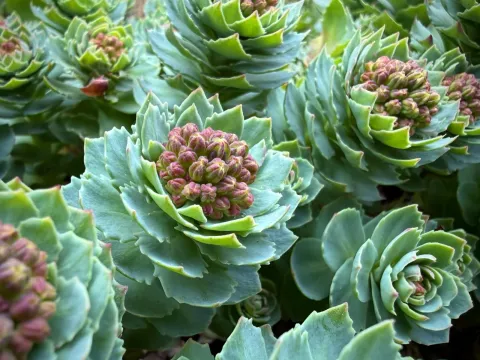
Rhodiola rosea
Rhodiola
Rhodiola rosea, a member of the Crassulaceae family, has extremely small seeds that require surface sowing onto a finely prepared substrate. The ideal time for planting is either in late autumn or early spring, provided that the seeds have undergone a cold stratification period of one to two months.
What the section contains

Rhodiola rosea
Vegetative propagation is the most common and efficient method, involving the division of mature rhizomes. This is best done in early spring before growth begins or in autumn; each division must contain at least two healthy buds and a portion of the thick, fleshy root system.
Transplanting seedlings into the field is carried out once they have developed two to three true leaves. A typical planting pattern involves spacing rows 40–50 cm apart, with individual plants placed 20–30 cm apart to ensure adequate space for the slow-growing root systems to expand.
To improve germination rates for commercial farming, growth stimulants are often utilized. When sowing in greenhouse trays, seeds should be covered with only a very thin layer of substrate (up to 0.5 cm), while constant moisture control is essential to prevent the delicate seeds from drying out.
In their first year, Rhodiola seedlings grow very slowly, forming only small rosettes. During this initial phase, rigorous weeding is critical, as competing vegetation can easily overwhelm the young plants, potentially leading to significant losses in the crop population.
Rhodiola rosea is a cold-hardy, high-altitude plant naturally adapted to harsh, mountain conditions. While it thrives in full sun, young plants often benefit from light shading in warmer climates to prevent the substrate from drying out during the critical establishment phase.
The plant requires light, well-draining soil with a neutral to slightly acidic pH. Waterlogging is extremely detrimental to Rhodiola, as it causes rhizome rot; therefore, in heavy clay soils, creating raised beds or adding sand is essential for successful cultivation.
While the plant has succulent features and is somewhat drought-tolerant once established, it requires regular moisture during the active growing season. Careful irrigation is necessary to avoid excessive wetness, which can quickly lead to fungal issues and root decay.
The optimal temperature range for Rhodiola growth is between 15°C and 20°C. If temperatures consistently exceed 25°C, plant growth slows significantly; in such environments, farmers often use protective netting or artificial shade to keep the roots cool and productive.
Organic amendments like well-rotted compost are preferred for soil preparation. It is advisable to avoid high nitrogen mineral fertilizers, as they can encourage excessive foliage growth at the expense of the root development, which is the primary economic target of the crop.
The commercial yield of Rhodiola rosea is heavily dependent on the age of the plantation. Harvest typically occurs between the 4th and 5th years, at which point the concentrations of active compounds, such as rosavin and salidroside, are at their peak for medicinal processing.
Under optimal management, growers can expect an average yield of 1.5 to 3 tons of dried roots per hectare. The first few years of the plantation involve very little yield, as the plants dedicate their energy to building the biomass of the underground rhizome structures.
Factors influencing final root mass include plant density and effective weed control. Implementing high-standard agronomic practices significantly boosts output, ensuring that the root systems are robust and free from damage caused by competing roots or soil-borne stressors.
The quality of the harvest is determined by the appearance and potency of the roots. High-quality Rhodiola features a distinct metallic, golden sheen when broken, which indicates a high content of active secondary metabolites that are highly valued in the herbal market.
After harvesting, the roots undergo a drying process where they lose a significant portion of their fresh weight (often reducing to 30–35% of the original mass). Planning for sufficient drying facilities is essential to manage large volumes of fresh harvest efficiently.
Fungal diseases, particularly rhizome and stem rot, pose the greatest threat to Rhodiola plantations. These issues primarily arise in poorly drained fields or during prolonged periods of excessive rainfall, making site selection and proper drainage the best forms of defense.
Powdery mildew may affect the foliage during the second half of the summer, especially when air humidity is high. Preventive applications of biological fungicides can help manage the infection and protect the plant's ability to store energy for root development.
Soil-dwelling pests like wireworms can cause significant damage by tunneling into the rhizomes. Effective control strategies include proper crop rotation and thorough soil cultivation before planting to reduce the pest population density within the field.
Aphids can occasionally attack young shoots, draining plant nutrients and weakening growth. Early detection through regular monitoring allows for targeted insecticide application, which helps minimize the impact on plant vitality while maintaining high harvest safety standards.
Rust diseases may also appear in cool, damp seasons. Good hygiene in the field, such as the complete removal and destruction of plant debris after the harvest, is vital to prevent fungal spores from overwintering and reinfecting the field in the following season.
Harvesting Rhodiola is a labor-intensive process that must be conducted with care to prevent root damage. The work is usually carried out in the autumn, once the foliage begins to yellow and die back, signaling that the plant has ceased growth and stored maximum nutrients.
Roots are extracted using specialized machinery or deep-cutting tools that lift the soil layer. Once extracted, the roots are immediately separated from the soil, and the aerial parts are removed to prepare the rhizomes for the cleaning and washing process.
Washing must be done quickly in cold, running water to remove dirt and impurities. It is crucial to avoid soaking the roots for too long, as this can lead to the leaching of water-soluble active compounds, which reduces the overall medicinal quality of the dry product.
Drying is performed in forced-air dryers at temperatures not exceeding 50–60°C. Careful temperature control is necessary to prevent the loss of heat-sensitive bioactive components while ensuring the roots are dried thoroughly enough to prevent mold during storage.
The finished, dried product should be brittle, clean, and free from contaminants. Proper storage in dry, dark, and well-ventilated conditions is essential to maintain the quality and shelf-life of the golden root for future distribution and processing.