
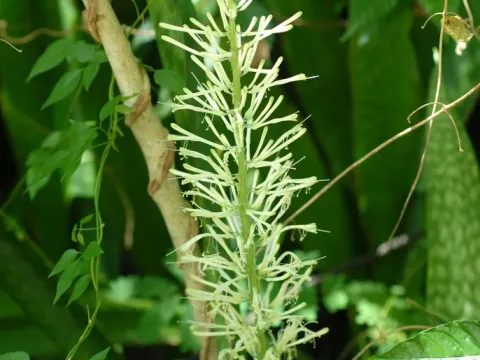
Sansevieria
Sansevieria Thunb.
Sansevieria, belonging to the Asparagaceae family, is primarily propagated through vegetative methods in commercial settings rather than by seeds. Growers typically use rhizome divisions or leaf cuttings to ensure faster establishment of the biomass required for industrial processing.
What the section contains
 Sansevieria aethiopica
 Thunb.
Sansevieria aethiopica
Sansevieria aethiopica Thunb.
 Sansevieria aethiopica hybrid
Sansevieria aethiopica Thunb x S. canaliculata Carrière
Sansevieria aethiopica hybrid
Sansevieria aethiopica Thunb x S. canaliculata Carrière
 Sansevieria aethiopica hybrid
Sansevieria aeethiopica x Sansevieria cylindrica
Sansevieria bracteata
Sansevieria bracteata Baker
Sansevieria aethiopica hybrid
Sansevieria aeethiopica x Sansevieria cylindrica
Sansevieria bracteata
Sansevieria bracteata Baker
 Sansevieria canaliculata
 Carrière
Sansevieria canaliculata
Sansevieria canaliculata Carrière
 Sansevieria cylindrica
 Bojer ex Hook.
Sansevieria cylindrica
Sansevieria cylindrica Bojer ex Hook.
 Sansevieria dooneri
 N. E. Br.
Sansevieria dooneri
Sansevieria dooneri N. E. Br.
 Sansevieria dooneri x parva
Sansevieria dooneri x Sansevieria parva
Sansevieria dooneri x parva
Sansevieria dooneri x Sansevieria parva
 Sansevieria ehrenbergii
 Schweinf. ex Baker
Sansevieria ehrenbergii
Sansevieria ehrenbergii Schweinf. ex Baker
 Sansevieria fischeri
 (Baker) Marais
Sansevieria fischeri
Sansevieria fischeri (Baker) Marais
 Sansevieria francisii
 Chahin.
Sansevieria francisii
Sansevieria francisii Chahin.
 Sansevieria gracilis
 N. E. Br.
Sansevieria gracilis
Sansevieria gracilis N. E. Br.
 Sansevieria kirkii
 Baker
Sansevieria kirkii
Sansevieria kirkii Baker
 Sansevieria parva
 N. E. Br.
Sansevieria parva
Sansevieria parva N. E. Br.
 Sansevieria robusta
 N. E. Br.
Sansevieria robusta
Sansevieria robusta N. E. Br.
 Sansevieria roxburghiana
 Schult. & Schult. f.
Sansevieria roxburghiana
Sansevieria roxburghiana Schult. & Schult. f.
 Sansevieria singularis
 N. E. Br.
Sansevieria singularis
Sansevieria singularis N. E. Br.
 Sansevieria zeylanica
 (L.) Willd.
Sansevieria zeylanica
Sansevieria zeylanica (L.) Willd.
 Snake plant
Sansevieria trifasciata Prain
Snake plant
Sansevieria trifasciata Prain
Sansevieria
The optimal time for planting occurs at the start of the growing season, once the soil has warmed sufficiently. In tropical regions, planting can be conducted nearly year-round provided that adequate soil moisture levels are maintained to support initial root development.
Planting density is calculated based on the primary purpose of the crop; for high-quality fiber production, a spacing of approximately 60–80 cm between rows is standard. This distance allows for optimal rosette growth while facilitating mechanical weeding and maintenance of the field.
Preparation of the site involves thorough clearing of existing vegetation and deep tillage. Because the plant features a robust and extensive root system, the soil must be loose and well-drained to prevent the rot of underground organs during the early stages of establishment.
The selection of the planting site should prioritize areas with minimal risk of waterlogging. Sansevieria is highly sensitive to stagnant water in the rhizosphere, making proper soil drainage a critical prerequisite even in environments with high ambient humidity.
This crop is a classic xerophyte, originating from the arid regions of Africa and South Asia. It demonstrates remarkable tolerance to soil moisture deficits, thanks to its specialized photosynthetic metabolism that minimizes water loss throughout the day.
Soil requirements involve a pH range of 5.5 to 7.5. The plant prefers light, sandy, or loamy substrates that allow for essential gas exchange, which is critical for the healthy development of thick rhizomes that store nutrients and ensure the plant's long-term survival.
The temperature regime for commercial cultivation should ideally remain between 18 and 30 degrees Celsius. Prolonged exposure to temperatures below 10 degrees can lead to tissue degradation in the leaves, negatively impacting the yield and quality of the technical fibers.
Light intensity plays a significant role in the accumulation of organic matter and the density of fibrous bundles. While the crop can tolerate partial shade, commercial operations prefer sites with bright, diffused light to ensure rapid leaf maturation and high fiber content.
Mineral nutrition must be balanced with a focus on potassium and phosphorus to strengthen the mechanical tissues of the leaves. Nitrogen fertilizers should be applied sparingly, as excessive amounts can promote succulent tissue growth at the expense of fiber strength and length.
The yield of Sansevieria as a technical crop is determined by the total mass of the leaf apparatus designated for processing. Under favorable climatic conditions, fresh mass output per hectare can be substantial, provided that optimal planting density is maintained.
The primary commercial product is Sansevieria fiber, which is extracted via the decortication of the leaves. The fiber content in fresh leaves typically ranges from 2 to 5 percent of the total mass, depending heavily on the specific cultivar and the agronomic environment.
The rate of biomass accumulation depends on the age of the plantation and the frequency of harvests. An optimal industrial lifecycle for a plantation lasts between 5 and 8 years, after which the productivity of individual rosettes declines, necessitating replanting.
Yield metrics fluctuate significantly based on water availability during critical development phases. Although the plant is drought-tolerant, supplemental irrigation during dry spells can increase leaf mass output by 20–30 percent, which is often economically justified.
Harvest records are maintained based on the mass of harvested leaves ready for immediate transport to processing plants. Prolonged storage of raw, harvested leaves is not recommended due to high moisture content and the risk of microbial spoilage, which degrades fiber quality.
The primary phytopathological threat to Sansevieria is fungal rot, which typically develops when moisture management protocols are breached. Pathogens such as Botrytis or Erwinia species can destroy a plantation rapidly if soil aeration is poor or water remains stagnant.
Pests such as mealybugs and spider mites represent significant threats in hot, arid climates. These pests target young leaves and growing points, leading to deformation and hindering the plant's overall development during all growth stages.
- Implement strict quarantine measures for all imported planting materials.
- Maintain optimal spacing between plants to ensure sufficient air circulation.
- Perform regular weeding of inter-row spaces to lower the local infection pressure.
- Conduct routine monitoring of plantation edges for early detection of infestations.
- Utilize selective bio-pesticides when pest thresholds are exceeded to minimize chemical impact.
Disease prevention involves the selection of rot-resistant cultivars and precise irrigation management. Drip irrigation systems allow water to be delivered directly to the root zone, avoiding the leaf surface and significantly reducing the risk of developing leaf spot diseases.
An integrated pest management system relies on biological control methods to maintain the ecological purity of the fiber. This is essential for meeting the stringent quality and safety standards required by textile and industrial manufacturing sectors.
Harvesting Sansevieria involves the mechanized or manual cutting of leaves at the base of the rosette. The optimal age for harvesting is when the leaf has reached full physiological maturity, ensuring that fiber content is at its peak and the leaf texture is sufficiently rigid.
To ensure continuous production cycles on large plantations, selective harvesting is common, where only the most developed leaves are removed. This approach allows the remaining parts of the rosette to continue photosynthesis and support the growth of the next generation of leaves.
Harvested raw materials must reach the processing facility within 24 hours. Delays can lead to a loss of fiber elasticity and increase the difficulty of cleanly separating the fiber from the leaf parenchyma during the decortication process.
Mechanized harvesting utilizes specialized cutters integrated with transportation platforms to reduce labor costs and ensure a uniform cut depth. This precision is vital for minimizing damage to the rhizome and promoting rapid regeneration of the plant for future harvest cycles.
Post-harvest, the plantation is cleared of debris to prevent the buildup of pathogens. In some management schemes, plant residues are incorporated into the soil as organic matter, provided they have been confirmed free of harmful infections.