

Reference · Crops
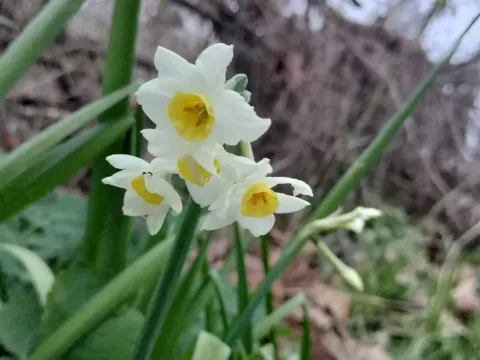
Daffodil
Narcissus L.
Daffodils are typically planted in late summer or autumn. This timing allows the bulbs to establish a strong root system before the ground freezes, which is critical for healthy spring blooming.
11
items
What the section contains
 Angel's tears daffodil
Narcissus triandrus L.
Angel's tears daffodil
Narcissus triandrus L.
 Cyclamen-flowered narcissus
Narcissus cyclamineus DC.
Cyclamen-flowered narcissus
Narcissus cyclamineus DC.
 Fragrant Narcissus
Narcissus x odorus L.
Fragrant Narcissus
Narcissus x odorus L.
 Hoop-petticoat daffodil
Narcissus romieuxii Braun-Blanq. & Maire
Hoop-petticoat daffodil
Narcissus romieuxii Braun-Blanq. & Maire
 Incomparable Narcissus
Narcissus x incomparabilis Mill.
Incomparable Narcissus
Narcissus x incomparabilis Mill.
 Jonquil
Narcissus jonquilla L.
Jonquil
Narcissus jonquilla L.
 Narcissus bulbocodium
 L.
Narcissus bulbocodium
Narcissus bulbocodium L.
 Narcissus minor
 L.
Narcissus minor
Narcissus minor L.
 Polyanthus narcissus
Narcissus tazetta L.
Polyanthus narcissus
Narcissus tazetta L.
 Rock daffodil
Narcissus rupicola Dufour
Rock daffodil
Narcissus rupicola Dufour
 Wild daffodil
Narcissus pseudonarcissus L.
Wild daffodil
Narcissus pseudonarcissus L.
Marketplace
Products in this section · 11


Daffodil
The ideal soil temperature for planting ranges between 8 and 10 degrees Celsius. Planting too late can result in poor root development and delayed growth in the following season.
The planting depth should be approximately three times the height of the bulb, ensuring at least 10-15 centimeters of soil coverage for proper protection.
In light, sandy soils, it is beneficial to plant slightly deeper, while in heavy clay soils, keeping bulbs closer to the surface with improved drainage is recommended to prevent waterlogging.
After planting, applying a layer of organic mulch helps regulate soil temperature and retains moisture, creating a stable environment during the cold months.
The daffodil (Narcissus L.) is a perennial bulbous plant belonging to the Amaryllidaceae family. It thrives in well-lit areas but can tolerate partial shade during the vegetative period.
These plants prefer fertile, well-drained, slightly acidic to neutral loam soils. Proper soil structure is essential as the bulbs are highly susceptible to rotting in waterlogged ground.
Moisture management is key during the spring growth phase, although the soil must never remain oversaturated with water for long periods, as this invites fungal infections.
Commercial cultivation requires site selection that provides protection from strong, drying winds, which can mechanically damage the leaves and floral stems.
Regular fertilization is standard practice, using nitrogen-rich fertilizers in early spring to support foliage development and potassium-phosphorus blends to encourage bud formation.
The crop is vulnerable to fungal diseases such as fusarium basal rot and gray mold, which are often exacerbated by poor storage conditions or high humidity in the soil.
Major pests include the narcissus bulb fly and nematodes. The larvae of the bulb fly feed on the interior of the bulb, effectively destroying the plant from within.
Implementing a strict crop rotation strategy is vital; daffodils should not be planted on the same soil for at least four to five years to prevent soil-borne pathogen buildup.
Preventive treatment with fungicides and insecticides is recommended before storing the bulbs to ensure that the planting stock remains healthy throughout the winter.
- Fusarium basal rot
- Gray mold (Botrytis)
- Narcissus bulb fly
- Stem and bulb nematodes
Harvesting should occur once the foliage has withered and turned yellow, which typically indicates that the bulb has entered its dormancy phase and stored sufficient energy.
After excavation, the bulbs must be carefully cleaned and air-dried in a shaded, well-ventilated location to harden the outer skin and prevent rot.
Sorting is an essential step post-harvest; all damaged, diseased, or pest-ridden bulbs must be removed to protect the remaining high-quality stock during storage.
Storage should be conducted at a temperature of 15 to 18 degrees Celsius in a dry, dark place with constant air circulation to maintain bulb vitality.
Using mesh containers is the best practice for storage, as it allows air to circulate freely around the bulbs and minimizes the risk of overheating or mold growth.