
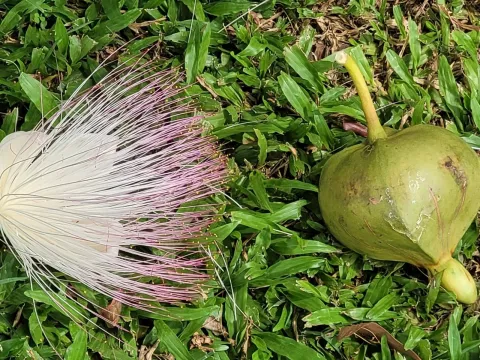
Barringtonia
Barringtonia
Barringtonia is a genus of evergreen trees and shrubs belonging to the Lecythidaceae family. These plants are native to the tropical regions of the Indo-Pacific, where they primarily thrive in coastal forests, mangrove swamps, and riverbanks.
What the section contains
 Barringtonia acutangula
Barringtonia acutangula
Barringtonia acutangula
 Barringtonia apiculata
Barringtonia apiculata
Barringtonia apiculata
 Barringtonia asiatica
Barringtonia asiatica
Barringtonia asiatica
 Barringtonia calyptrata
Barringtonia calyptrata
Barringtonia calyptrata
 Barringtonia edulis
Barringtonia lauterbachii
Barringtonia lauterbachii
Barringtonia edulis
Barringtonia edulis
Barringtonia lauterbachii
Barringtonia lauterbachii
 Barringtonia macrostachya
Barringtonia macrostachya
Barringtonia macrostachya
 Barringtonia pendula
Barringtonia pendula
Barringtonia pendula
 Barringtonia procera
Barringtonia procera
Barringtonia procera
 Barringtonia racemosa
Barringtonia revoluta
Barringtonia revoluta
Barringtonia racemosa
Barringtonia racemosa
Barringtonia revoluta
Barringtonia revoluta
 Barringtonia samoensis
Barringtonia samoensis
Barringtonia samoensis
 Barringtonia sarcostachys
Barringtonia sarcostachys
Barringtonia sarcostachys
 Barringtonia scortechinii
Barringtonia scortechinii
Barringtonia scortechinii
Barringtonia
The culture requires a tropical climate with high, stable temperatures throughout the year. It is extremely sensitive to frost and cold stress, making it unsuitable for cultivation in temperate climates without controlled greenhouse environments.
In terms of soil, Barringtonia prefers deep, fertile, and moist substrates. The plant is remarkably tolerant of saline conditions, which allows it to be grown in coastal areas where soil salinity levels prevent the cultivation of many other agricultural crops.
Agricultural management centers on water availability. As a species that naturally populates wetland areas, the plant requires consistent irrigation to maintain soil moisture levels and prevent physiological stress caused by drought.
Propagation is primarily conducted through seeds. The seeds are characterized by their natural buoyancy, allowing them to remain viable while floating in seawater, which is a key biological adaptation that needs to be replicated in nursery settings.
Barringtonia is susceptible to various pests, most notably leaf-eating caterpillars that can significantly reduce photosynthetic activity if left unchecked. Regular field inspections are necessary for effective management.
Root rot and fungal infections are common when the plant is grown in waterlogged conditions with poor drainage. These pathogens can compromise the structural integrity and overall health of the tree in a short period.
Leaf spot diseases can also occur in high-humidity environments where airflow is restricted. Proper spacing between individual trees is essential to ensure adequate air circulation and reduce the incidence of fungal outbreaks.
Integrated pest management (IPM) practices are recommended to mitigate threats. This includes the use of bio-rational pesticides and organic interventions to control pest populations without disrupting the local ecological balance.
Sanitation practices, such as the removal of dead wood and diseased leaves, play a crucial role in maintaining the health of the plantation and preventing the spread of diseases within the crop.