
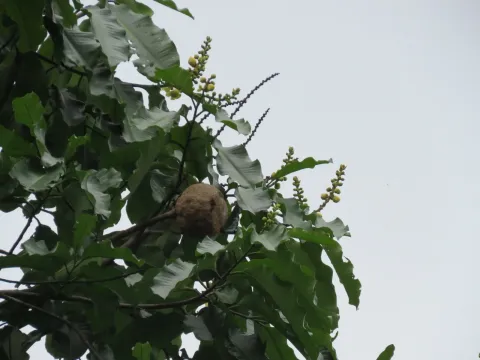
Brazil nut
Bertholletia
The Brazil nut tree (Bertholletia excelsa), belonging to the Lecythidaceae family, is typically propagated from seeds in its native rainforest environment, where dispersal relies on local wildlife.
What the section contains

Brazil nut
For commercial cultivation, seeds are sown in specialized nurseries with careful attention to moisture and temperature, as early-stage growth is notoriously slow.
Transplanting seedlings to their final location is best executed at the beginning of the rainy season to ensure the root system establishes well in the soil.
Modern plantations increasingly rely on grafting techniques using selected clones to ensure uniform fruit production and to reduce the time until the first harvest.
Due to the massive size of the mature tree, which can grow up to 50 meters, growers must provide ample spacing between plants to prevent overcrowding and ensure sunlight access.
Bertholletia excelsa is a tropical crop that demands consistently high temperatures throughout the year, with minimal seasonal fluctuation to maintain growth.
The species thrives in deep, well-drained, nutrient-rich alluvial soils, commonly found in the Amazon basin, where organic matter is abundant.
High humidity and consistent rainfall are essential for the healthy development of the tree, as it lacks significant drought-tolerance mechanisms.
Waterlogging is a major risk factor; therefore, plantations must be situated on well-draining terrain to prevent root rot and physiological stress to the plants.
Successful pollination is highly dependent on the presence of large wild bees, specifically from the Bombus and Centris genera, making ecological management vital.
Brazil nut trees are known for their long juvenile period, typically requiring 12 to 20 years of growth before they begin to produce their first significant commercial yields.
A single mature, healthy tree can produce between 100 and 300 hard, woody fruits per season, each containing numerous nuts protected by a thick shell.
The total weight of the seeds harvested from one tree can reach significant levels, making the species a high-value commodity in sustainable agroforestry systems.
Productivity is closely linked to the health of the surrounding ecosystem, which supports the necessary insect populations for cross-pollination of the flowers.
Yield stability is improved through proper plantation management, including selective pruning and monitoring of soil fertility to support the long-term vigor of the trees.
Various insect pests represent the primary threat to Brazil nut production, as they can cause damage to flowers and young fruit, leading to significant crop losses.
Fungal pathogens affecting the root system are often linked to poor drainage or soil compaction, which can weaken the tree over time if not addressed properly.
Parasitic plants and vigorous vines may climb the trees, competing for sunlight and nutrients, and potentially causing structural damage to the branches.
The decline of natural pollinator habitats due to land-use changes remains one of the most pressing agronomic risks for large-scale Brazil nut plantations.
Mechanical damage to the trunk during harvesting or maintenance can serve as an entry point for wood-decay fungi, impacting the tree's health and lifespan.
Harvesting is traditionally performed by collecting the heavy, woody fruits from the forest floor after they have fallen naturally from the canopy upon ripening.
The fallen fruits are hazardous due to their weight and the height from which they descend, requiring workers to wear protective gear during collection operations.
Once gathered, the fruits are transported to processing centers where they are carefully opened to extract the nuts contained within the capsules.
Post-harvest processing involves cleaning, drying the nuts to a specific moisture content, and sorting them by size and quality for global distribution.
Proper drying is critical to prevent the growth of aflatoxin-producing fungi, ensuring the safety and quality of the final product for international trade.