

Reference · Diseases
Fungal diseases
Powdery mildew is a common fungal disease affecting a wide range of plants, caused by various species of fungi within the order Erysiphales. These fungi are obligate parasites, meaning they must live on a host plant to survive, extracting nutrients via specialized structures called haustoria that penetrate the epidermal cells.
9 655
items
What the section contains
 Thalassiosira
Thalassiosira pseudonana
Thalassiosira pseudonana
Thalassiosiraceae
Thalassiosiraceae
Thalassiosira
Thalassiosira
Thalassiosira pseudonana
Thalassiosira pseudonana
Thalassiosiraceae
Thalassiosiraceae
 Thalassiosirales algae
Thalassiosirales
Thalassiosirales algae
Thalassiosirales
 Thamnolia
Thamnolia
Thamnolia
 Thamnolia vermicularis
Thamnolia vermicularis
Thamnolia vermicularis
 The Blusher
Amanita rubescens
The Blusher
Amanita rubescens
 The Prince
Agaricus augustus
The Prince
Agaricus augustus
 The sickener
Russula emetica
The sickener
Russula emetica
 Thecaphora
Thecaphora alsinearum
Thecaphora alsinearum
Thecaphora amaranth smut
Thecaphora amaranthi
Thecaphora cerastii
Thecaphora cerastii
Thecaphora cuneata
Thecaphora cuneata
Thecaphora hennenii
Thecaphora hennenii
Thecaphora italica
Thecaphora italica
Thecaphora
Thecaphora
Thecaphora alsinearum
Thecaphora alsinearum
Thecaphora amaranth smut
Thecaphora amaranthi
Thecaphora cerastii
Thecaphora cerastii
Thecaphora cuneata
Thecaphora cuneata
Thecaphora hennenii
Thecaphora hennenii
Thecaphora italica
Thecaphora italica
 Thecaphora melandrii
Thecaphora melandrii
Thecaphora melandrii
 Thecaphora saponariae
Thecaphora saponariae
Thecaphora saponariae
 Thekopsora
Thekopsora
Thekopsora
 Thelebolaceae
Thelebolales
Thelebolales
Thelebolaceae
Thelebolaceae
Thelebolales
Thelebolales
 Thelebolus
Thelebolus
Thelebolus
 Thelebolus stercoreus
Thelebolus stercoreus
Thelebolus stercoreus
 Thelenella
Thelenella cinerascens
Thelenella cinerascens
Thelenella lichens
Thelenellaceae
Thelenella
Thelenella
Thelenella cinerascens
Thelenella cinerascens
Thelenella lichens
Thelenellaceae
 Thelenella muscorum
Thelenella muscorum
Thelenella muscorum
 Thelephora
Thelephora
Thelephora
 Thelephora anthocephala
Thelephora anthocephala
Thelephora anthocephala
 Thelephora palmata
Thelephora palmata
Thelephora palmata
 Thelephora penicillata
Thelephora penicillata
Thelephora penicillata
 Thelephoraceae fungi
Thelephoraceae
Thelephoraceae fungi
Thelephoraceae
 Thelephorales
Thelohania
Thelohania
Thelohaniosis
Thelohaniidae
Thelephorales
Thelephorales
Thelohania
Thelohania
Thelohaniosis
Thelohaniidae
 Thelonectria
Thelonectria coronata
Thelonectria coronata
Thelonectria
Thelonectria
Thelonectria coronata
Thelonectria coronata
 Thelonectria lucida
Thelonectria olida
Thelonectria olida
Thelonectria viridispora
Thelonectria viridispora
Thelonectria lucida
Thelonectria lucida
Thelonectria olida
Thelonectria olida
Thelonectria viridispora
Thelonectria viridispora
 Thelotrema
Thelotrema
Thelotrema
 Thelotrema petractoides
Thelotremataceae
Thelotremataceae
Thermomyces lanuginosus
Thermomyces lanuginosus
Thermomycosis
Thermomyces
Thermophilic Phytophthora
Phytophthora thermophila
Therrya
Therrya
Thelotrema petractoides
Thelotrema petractoides
Thelotremataceae
Thelotremataceae
Thermomyces lanuginosus
Thermomyces lanuginosus
Thermomycosis
Thermomyces
Thermophilic Phytophthora
Phytophthora thermophila
Therrya
Therrya
 Therrya pini
Therrya pini
Therrya pini
 Thick-footed morel
Morchella crassipes
Thick-footed morel
Morchella crassipes
 Thielaviopsis
Thielaviopsis
Thielavia
Thielaviopsis
Thielaviopsis
Thielaviopsis
Thielavia
 Thielaviopsis paradoxa
Thielaviopsis paradoxa
Thielaviopsis paradoxa
 Thimble Morel
Verpa conica
Thimble Morel
Verpa conica
 Thistle rust
Puccinia cnici-oleracei
Thistle rust
Puccinia cnici
Thistle rust
Puccinia cnici-oleracei
Thistle rust
Puccinia cnici
 Thistle rust
Puccinia cirsii
Thistle rust
Puccinia cirsii
 Thousand Cankers Disease
Geosmithia morbida
Thousand Cankers Disease
Geosmithia morbida
 Thraustochytriaceae
Thraustochytriaceae
Thraustochytriaceae
 Thraustochytriales
Thread blight
Corticium koleroga
Thraustochytriales
Thraustochytriales
Thread blight
Corticium koleroga
Marketplace
Products in this section · 12


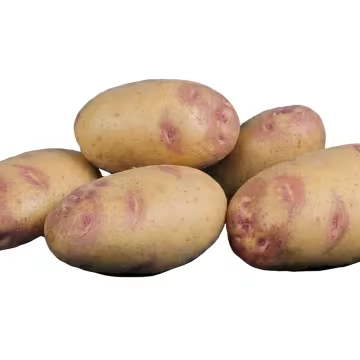
Fungal diseases
The disease attacks a vast array of crops, including cereals, vegetables, fruit trees, and ornamental plants. Crops like cucumbers, grapes, roses, and apples are particularly susceptible, making powdery mildew one of the most frequently encountered challenges in both commercial agriculture and home gardening.
The most recognizable symptom is the development of a white or grayish, powdery-looking fungal growth on the surface of leaves, stems, and flowers. As the infection progresses, the powdery spots expand and merge. Heavily infested tissues may become yellowed, distorted, stunted, or develop necrotic spots, eventually leading to leaf drop.
The fungus thrives in conditions of high humidity (without direct moisture on leaves) and moderate temperatures, typically between 18°C and 25°C. Poor air circulation caused by overcrowding, as well as excessive nitrogen fertilization which promotes lush but tender new growth, significantly increase the plant's susceptibility to the pathogen.
The economic impact of powdery mildew is severe, as the disease reduces the plant's photosynthetic capacity, leading to reduced vigor and diminished crop yields. In commercial fruit and vegetable production, the cosmetic damage caused by the fungus often renders the produce unmarketable, leading to substantial financial losses.
Effective management and prevention strategies include:
- Selecting plant varieties with documented resistance to powdery mildew.
- Maintaining proper spacing between plants to improve airflow and reduce humidity around the foliage.
- Pruning and removing infected plant parts to limit the source of inoculum.
- Applying a balanced fertilizer regime to avoid excessive nitrogen stimulation.
- Using preventative or curative fungicides, such as sulfur-based products, potassium bicarbonate, or systemic triazoles.