
Thistle rust
Puccinia cnici-oleracei
Description
Symptoms
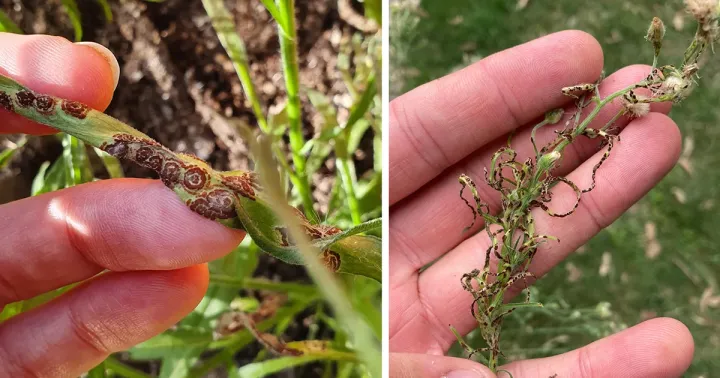
The first visual signs of infection are small yellowish or orange spots on the upper side of the thistle leaves, which darken over time. This initial stage indicates the active development of fungal sporulation within the plant tissues.
Later, characteristic pustules form on the underside of the leaves and sometimes on stems. These appear as rusty-brown powdery cushions that may merge, covering significant portions of the leaf and impairing its physiological functions.
As the disease progresses, infected tissues yellow and wither prematurely. The plant loses photosynthetic capacity, leading to a disruption in the overall metabolism and energy balance of the thistle.
Severe infection is often accompanied by stem deformation and stunted growth of the entire plant. Thistle appears noticeably weakened, developing poorly and often failing to produce viable reproductive organs or flowers.
Toward the end of the season, the pustules turn dark brown or almost black. This indicates that the fungus is transitioning into the overwintering spore phase, ensuring the persistence of the pathogen for the next year.
Pathogen
The causative agent of this disease is the specialized microscopic fungus Puccinia cnici-oleracei, which belongs to the class Basidiomycota. This pathogen is an obligate parasite, meaning it depends entirely on the living tissues of its host plant to complete its lifecycle.
The fungus primarily infects members of the Asteraceae family, particularly various species of thistle. The pathogen can survive on crop residues and in the soil, providing a source of primary infection at the beginning of the growing season.
The fungal biology includes the development of various spore stages, allowing it to spread rapidly throughout the summer and adapt to seasonal changes. This complex cycle ensures the parasite's high survival rate in various environments.
The fungal mycelium develops within the plant tissues, penetrating intercellular spaces. Through specialized structures called haustoria, the parasite absorbs nutrients, which gradually exhausts the weed and reduces its competitive ability against crops.
The infection process begins when spores land on the leaf surface, germinate, and penetrate the epidermis. The pathogen exhibits high host specificity, limiting its impact to particular weed species and acting as a natural regulator of thistle populations.
Conditions for development
The development and spread of thistle rust are favored by high humidity and moderate temperatures. Dew or rainwater on leaf surfaces is a critical factor for the successful germination of fungal spores.
Optimal temperatures for the fungus range between 15 and 22 degrees Celsius. Under these conditions, the pathogen produces new generations of spores most intensively, which are then carried by the wind to neighboring plants.
Dense thickets of thistles create a unique microclimate with high humidity levels. Such conditions are ideal for the rapid spread of the disease within a weed population, often leading to localized epidemics.
Lack of direct sunlight inside dense foliage also promotes fungal growth by slowing the evaporation of moisture from leaves. This stability allows the pathogen to efficiently infect a large number of host plants.
The peak of disease activity typically occurs in mid-summer when thistle biomass is at its maximum, providing the parasite with an abundant supply of nutrients to support vigorous sporulation.
Why it matters
The primary harm caused by thistle rust is the suppression of weed growth, which decreases its ability to compete for water, nutrients, and sunlight with crops. Weakened weeds become significantly less problematic in agricultural fields.
However, there is a potential risk if the pathogen crosses over to related crops, though this is rare due to the narrow host range of most rust fungi. In most cases, the pathogen acts as a natural biological control agent.
The depletion of nutrient reserves in the roots severely weakens perennial thistle plants. This leads to reduced vigor in the following season, potentially causing the eventual death of the weed during winter dormancy due to energy deficits.
Mass outbreaks of the disease can effectively regulate thistle populations in pastures and field margins. This makes the fungus a valuable component of sustainable weed management strategies in various ecosystems.
Economic damage from thistle rust is minimal, as it primarily targets non-crop weeds. For agronomists, it is often viewed as a beneficial natural factor that reduces the density of invasive thistle stands.
Protection
Specific chemical control against thistle rust is generally not practiced in commercial farming, as the thistle itself is the target for herbicide application. Fungicides are rarely used unless there is a threat to susceptible crop varieties.
Adherence to crop rotation is an effective preventive method to limit the accumulation of pathogens in the soil. Diverse cropping systems help in naturally reducing weed pressure, including those susceptible to rust.
Mechanical soil cultivation, such as deep plowing, helps destroy plant residues that harbor overwintering spores. This practices disrupts the infection cycle and minimizes early-season pathogen buildup.
Mowing thistles in border areas before they reach the sporulation stage is a crucial preventive measure. This limits spore dispersal to nearby fields and keeps the overall infection background low.
- Regular monitoring of fields for signs of rust disease.
- Removal of weed reservoirs along field margins.
- Use of certified, weed-free seed material.
- Optimizing nutrient levels to ensure strong, healthy crops.
- Strategic field management to minimize weed competition.
Discussion
No discussions yet — be the first.