
Thelenella muscorum
Thelenella muscorum
Description
Symptoms
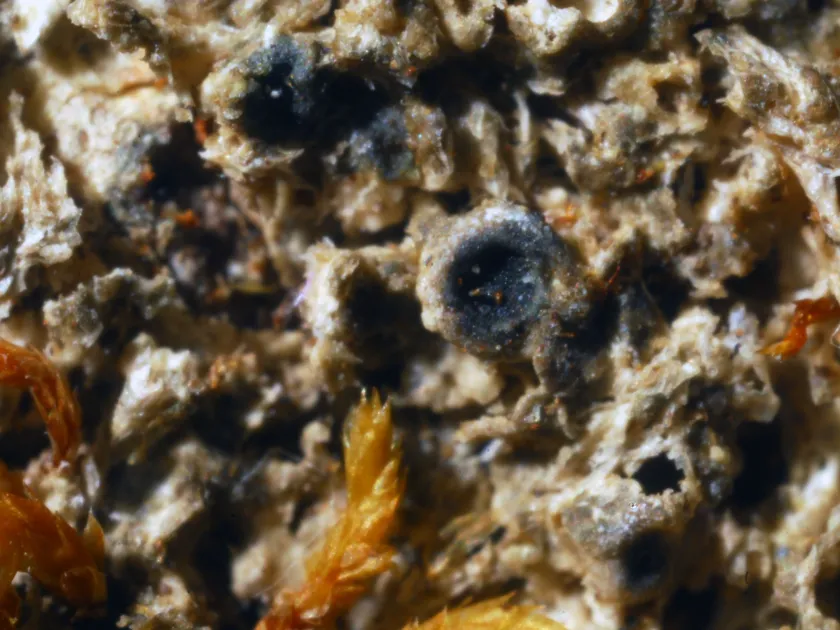
Thelenella muscorum is a species of crustose lichen frequently found on bark or bryophytes. It forms a thin, sometimes barely visible thallus that adheres tightly to the surface of the substrate.
The color of the thallus typically ranges from grayish to white, appearing as a crust-like covering. It does not exhibit the leaf-like or branching forms seen in more conspicuous lichen species.
The defining feature of this species is the presence of tiny, immersed fruiting bodies known as perithecia. These appear as minute, black, dot-like structures scattered across the thallus surface.
Because of its crustose growth pattern, it is often overlooked or mistaken for simple bark discoloration or mineral deposits rather than a living biological organism.
The lichen thrives in localized moist microclimates, making it common on the sheltered sides of tree trunks where humidity remains relatively stable.
Pathogen
From a phytopathological perspective, Thelenella muscorum is not a plant pathogen. It is an epiphytic lichenized fungus that exists in a symbiotic relationship with an algae.
The lichen does not parasitize the tree's living tissues. It utilizes the bark surface purely as a mechanical substrate for attachment and orientation toward available light.
It does not extract nutrients, water, or sap from the tree, and it does not secrete substances that harm the cambium or conducting vessels of the host plant.
In biological literature, such organisms are classified as epiphytes, meaning they grow on another plant but are not dependent on it for nourishment.
Consequently, identifying this lichen on tree bark should not cause concern regarding the plant's health, as it is completely neutral to the physiological processes of the tree.
Conditions for development
The development and spread of this lichen are heavily dependent on environmental humidity and light levels. It prefers shaded, humid environments that discourage rapid evaporation.
Mature trees with thick, rough, or fissured bark provide the most suitable physical structure for the colonization and establishment of Thelenella muscorum spores.
Air quality is a significant factor, as most lichens are sensitive to atmospheric pollution. The presence of this lichen often indicates a relatively clean, non-industrial environment.
Poor orchard management, such as a lack of regular pruning, can lead to the formation of dense, stagnant microclimates within the canopy, which encourages lichen growth.
Dispersal is achieved through spores that are carried by air currents or moisture to settle on new, suitable surfaces for germination and growth.
Why it matters
Thelenella muscorum does not cause direct harm to trees. It does not contribute to disease development, nor does it weaken the structural integrity of the plant.
There is very little indirect harm associated with this species. In very dense populations, it might harbor small insects or mites, but this is usually negligible for the overall tree health.
Concerns regarding gas exchange interference are largely theoretical; in practice, the growth rate of this lichen is usually slow enough that it does not impede the tree's physiological function.
Often, the visibility of lichens on tree bark is simply a visual indicator of an old tree or one that has not been recently cleaned, rather than an active disease.
No chemical control is required, as the species is essentially harmless and ecologically valuable as part of the local biodiversity.
Protection
Since this organism is not a disease-causing agent, no specific control measures are needed. Garden management should focus on general health and sanitation.
- Regular pruning of the canopy to improve air circulation and light penetration.
- Cleaning trunks of dead bark to remove potential substrate for lichen colonization.
- Applying whitewash to tree trunks as a standard protective measure to maintain bark hygiene.
- Maintaining optimal irrigation and fertilization to ensure vigorous tree growth and regular bark shedding.
- Monitoring the garden's overall microclimate to prevent excessive moisture stagnation.
Discussion
No discussions yet — be the first.