
Thelenella
Thelenella
Description
Symptoms
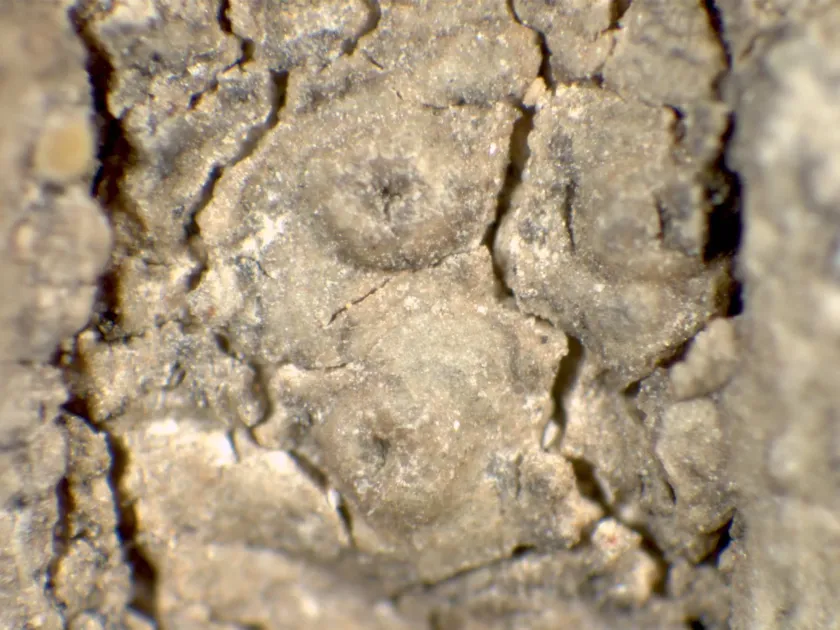
The primary sign of Thelenella presence is the appearance of specific patches on trunks and skeletal branches. These patches usually have a grey, greenish, or whitish hue.
The lichen thallus adheres tightly to the bark, creating visually noticeable coatings. Upon closer inspection, one can observe apothecia—fruiting bodies that look like tiny dark dots.
Unlike mosses, lichens of the Thelenella genus do not have distinct leaves or stems. They appear as a dense, sometimes granular or cracked crust that covers the outer layer of the periderm.
Symptoms are often found on the sunny side of the tree, where lichens can develop more intensely if sufficient humidity is present. They do not cause tissue necrosis but obscure the true condition of the bark.
The presence of the lichen becomes especially noticeable during wet weather when the thallus absorbs water and takes on a more vibrant color.
Pathogen
Thelenella is a genus of lichens that belong to the epiphyte group. Unlike pathogenic fungi that cause infectious diseases, Thelenella is a symbiotic organism composed of a fungus and an alga.
Biologically, this organism is not a pathogen in the traditional phytopathological sense. It settles on the bark of trees, using the tree exclusively as a substrate for attachment rather than as a source of nutrients.
Species of the genus Thelenella are frequently found in forest ecosystems and old orchards. They possess a characteristic thallus, which can vary from a thin crust to more defined structures that adhere tightly to the wood surface.
Reproduction occurs via spores, which are dispersed by wind or water droplets. Upon landing on suitable bark, the spores germinate, forming a new thallus that slowly colonizes the tree surface.
Studying this genus is important for assessing the overall health of an orchard. The presence of lichens often indicates a slowing of tree growth processes or advanced tree age.
Conditions for development
The main condition for colonization by Thelenella is high air humidity. In neglected orchards with poor air circulation, the risk of lichen occurrence is significantly higher.
Old trees with dying bark are an ideal substrate for settlement. Cracks and roughness on the bark retain moisture and lichen spores, creating a favorable environment for their establishment.
Dense tree canopies create shade and prevent the trunk from drying quickly after rain. This maintains a constant level of hydration, which is necessary for lichen survival.
Poor horticultural practices, such as lack of pruning and orchard floor maintenance, also contribute to the spread of these epiphytes across the garden.
The absence of chemical treatments against fungal diseases can also indirectly promote lichen development, as broad-spectrum fungicides often inhibit their growth.
Why it matters
Although Thelenella does not feed on plant sap, its harmfulness lies in creating an unfavorable microclimate beneath the thallus. It can retain excess moisture, which may provoke the development of secondary bark rot.
The dense coating on the bark hinders normal gas exchange between the wood tissues and the environment. This can negatively impact the vital processes of aging trees.
Lichens create ideal shelters for overwintering stages of pests such as scale insects, soft scales, and mites. This makes effective insecticide applications more difficult.
In aesthetic and commercial terms, the presence of lichens reduces the market value of nursery saplings and adult trees, which can be critical for the sale of plant material.
General weakening of a tree due to other pathogens makes it more susceptible to colonization by epiphytes, which completes the cycle of declining plant health.
Protection
The primary method of control is regular mechanical cleaning of trunks and large branches to remove dead bark. This procedure is best performed during damp weather when the lichen tissue softens.
- Using garden scrapers or stiff brushes to clean the bark.
- Whitewashing trunks with lime and copper sulfate after cleaning.
- Sanitary pruning to improve canopy aeration.
- Regular fertilization to support active growth and bark renewal.
- Applying specialized preventive fungicide sprays permissible during the tree dormancy period.
Prevention relies on maintaining optimal tree planting density to prevent air stagnation. It is also important to maintain orchard hygiene by removing plant debris.
Spraying with an iron sulfate solution in early spring effectively suppresses lichen development in the initial stages of their appearance.
Discussion
No discussions yet — be the first.