
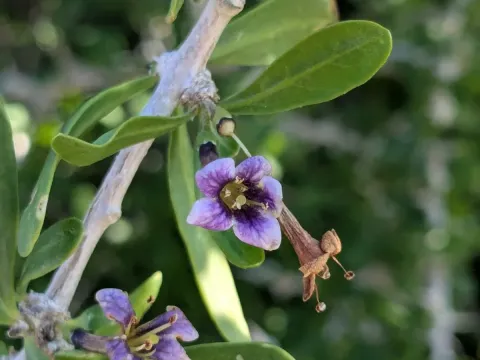
Schweinfurth's boxthorn
Lycium schweinfurthii
Schweinfurth's boxthorn (Lycium schweinfurthii) is a perennial shrub species belonging to the Solanaceae family. It is a highly specialized plant adapted to thrive in extreme ecological conditions, including coastal dunes and saline habitats that are inhospitable to most conventional crops.
What the section contains
Schweinfurth's boxthorn
The native distribution of this species spans across the Mediterranean basin and North Africa. It has evolved specific physiological mechanisms to regulate salt accumulation in its tissues, allowing it to survive in soils with high mineral concentrations and limited freshwater availability.
For optimal growth, this culture requires full sun exposure and well-draining soil structures. It is extremely tolerant to drought and high temperatures, making it a critical subject for research into sustainable agriculture in changing climate zones.
The root system of the Lycium schweinfurthii is extensive, providing structural stability to sandy substrates. Agricultural management involves minimal soil preparation, focusing primarily on establishing the plants in areas where erosion control is required.
Economic utility of this plant is centered on its role in environmental engineering and phytoremediation. By stabilizing vulnerable soils, it prevents desertification and contributes to the restoration of biodiversity in arid and semi-arid regions.
While the plant is naturally resistant to many pests due to its specific chemical composition, it may occasionally suffer from infestations of mites or aphids in dense plantations. Proper spacing is recommended to improve air circulation and reduce pest pressure.
Fungal infections are generally limited to instances of waterlogging. Ensuring that the soil remains aerated and that there is no stagnation of water is the most effective cultural practice to prevent pathogens from compromising the health of the root system.