
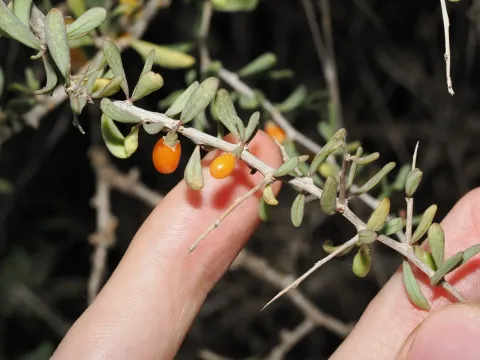
Southern boxthorn
Lycium australe
Southern boxthorn (Lycium australe) is a perennial shrub belonging to the Solanaceae family. Native to Australia, it is well-known for its extraordinary ability to thrive in arid and saline environments where many other crops would fail.
What the section contains
Southern boxthorn
The plant exhibits remarkable xerophytic adaptations, such as reduced leaf size and dense branching patterns. These features are critical for maintaining internal water balance during long periods of severe heat and low rainfall.
Regarding soil, Lycium australe prefers well-drained sandy or loamy soils. It demonstrates a high tolerance for alkaline and salty soil profiles, which makes it an excellent candidate for rehabilitating degraded or damaged lands.
Sunlight exposure is a mandatory requirement for this species. It demands full sun to achieve optimal growth rates and to prevent the development of various fungal pathogens that thrive in damp, shaded conditions.
The climate must be characterized by hot, dry summers. While the plant can survive cold winter temperatures, it performs best in regions where the thermal regime allows for a prolonged and active growing season without frost damage.
The primary threat to the health of Southern boxthorn is root rot, triggered by waterlogged soil conditions. Proper site selection and soil drainage are the most effective management tools against this issue.
Common agricultural pests like aphids can infest the growing tips during the spring flush. Monitoring these populations is essential to prevent stunted growth and loss of vegetative mass in younger shrubs.
Spider mites are another significant challenge in arid environments. These pests can rapidly multiply on the undersides of leaves, especially when the plant is under water stress, necessitating careful irrigation management.
Powdery mildew may develop if there is insufficient airflow between the plants. To mitigate this risk, it is recommended to maintain adequate spacing when establishing new rows to facilitate natural ventilation.
Mechanical damage to the stems can lead to fungal cankers. It is vital to perform pruning and maintenance operations with care to minimize wounds, as these provide entry points for secondary infections.