
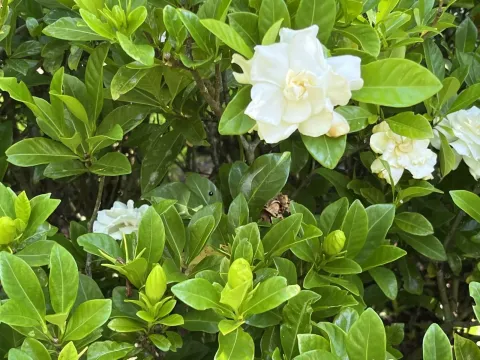
Gardenia
Gardenia
Gardenia is a genus of flowering plants in the family Rubiaceae, native to the tropical and subtropical regions of Africa, Asia, and the Pacific Islands. These evergreen shrubs are highly valued for their fragrant flowers and glossy foliage.
What the section contains
 Gardenia aubryi
Gardenia aubryi
Gardenia aubryi
 Gardenia carinata
Gardenia carinata
Gardenia carinata
 Gardenia cornuta
Gardenia cornuta
Gardenia cornuta
 Gardenia coronaria
Gardenia coronaria
Gardenia coronaria
 Gardenia erubescens
Gardenia forsteniana
Gardenia forsteniana
Gardenia erubescens
Gardenia erubescens
Gardenia forsteniana
Gardenia forsteniana
 Gardenia jovis-tonantis
Gardenia posoquerioides
Gardenia posoquerioides
Gardenia jovis-tonantis
Gardenia jovis-tonantis
Gardenia posoquerioides
Gardenia posoquerioides
 Gardenia resiniflua
Gardenia sokotensis
Gardenia sokotensis
Gardenia resiniflua
Gardenia resiniflua
Gardenia sokotensis
Gardenia sokotensis
 Gardenia sootepensis
Gardenia sootepensis
Gardenia sootepensis
 Gardenia tannaensis
Gardenia tannaensis
Gardenia tannaensis
 Gardenia ternifolia
Gardenia ternifolia
Gardenia ternifolia
 Gardenia thunbergia
Gardenia thunbergia
Gardenia thunbergia
 Gardenia tinneae
Gardenia tinneae
Gardenia tinneae
 Gardenia tubifera
Gardenia tubifera
Gardenia tubifera
 Gardenia urvillei
Gardenia urvillei
Gardenia urvillei
 Gardenia volkensii
Gardenia volkensii
Gardenia volkensii
 Imperial Gardenia
Gardenia imperialis
Imperial Gardenia
Gardenia imperialis
 Tahitian gardenia
Gardenia taitensis
Tahitian gardenia
Gardenia taitensis
Gardenia
Successful cultivation requires a climate that mimics their native environment, characterized by high atmospheric humidity and moderate temperatures. Commercial growers typically maintain daytime temperatures between 20°C and 25°C to ensure steady plant development.
Soil requirements are specific: gardenias thrive in acidic, well-draining soil with a pH ranging from 4.5 to 5.5. Proper soil acidity is essential for the uptake of essential nutrients, particularly iron, which is frequently limited in standard potting mixes.
Light management is crucial, as gardenias require bright, indirect light. Direct sunlight, especially during peak summer hours, can lead to foliage scorch, whereas insufficient light leads to sparse branching and a failure to set flower buds.
Irrigation must be performed using soft, limestone-free water. The presence of carbonates in the water can rapidly shift the soil pH, leading to iron chlorosis and a decline in plant health, making water quality testing a standard procedure in nurseries.
The primary pests affecting gardenia production are spider mites, whiteflies, and mealybugs. These sap-sucking insects colonize the undersides of leaves and leaf axils, causing stunted growth, yellowing, and potential drop of developing floral buds.
Root rot, primarily caused by Phytophthora species, is a common threat in nursery settings. It is often triggered by poor drainage and excessive irrigation, leading to rapid collapse of the root system and plant mortality.
Leaf spot diseases, caused by various fungal pathogens, appear as dark, necrotic lesions on the leaves. These often manifest in environments with poor air circulation and excessive humidity levels during nighttime hours.
Bud drop is a significant physiological disorder that can be triggered by sudden changes in temperature, erratic watering, or low light levels. This condition severely impacts the market value of the crop in floriculture.
Integrated Pest Management (IPM) is highly recommended. This involves the use of biological controls, routine sanitation of the growing area, and the application of specific miticides or fungicides only when infestation thresholds are exceeded.