

Reference · Crops
Thyme
Thymus L.
The sowing of Thyme (Thymus L.) requires precision due to the tiny size of the seeds. In commercial settings, direct seeding is performed during early spring once soil temperatures reach at least 10-12 degrees Celsius to ensure steady germination.
11
items
What the section contains
 Breckland thyme
Thymus serpyllum L.
Breckland thyme
Thymus serpyllum L.
 Caraway thyme
Thymus herba-barona Loisel.
Caraway thyme
Thymus herba-barona Loisel.
 Creeping thyme
Thymus praecox Opiz
Creeping thyme
Thymus praecox Opiz
 Daurian thyme
Thymus quinquecostatus Čelak.
Daurian thyme
Thymus quinquecostatus Čelak.
 Large-leaved thyme
Thymus pulegioides L.
Large-leaved thyme
Thymus pulegioides L.
 Lemon thyme
Thymus x citriodorus (Pers.) Schreb.
Lemon thyme
Thymus x citriodorus (Pers.) Schreb.
 Mastichina thyme
Thymus mastichina (L.) L.
Mastichina thyme
Thymus mastichina (L.) L.
 Nummular thyme
Thymus nummularius bieb
Nummular thyme
Thymus nummularius bieb
 Pallas thyme
Thymus pallasianus Heinr. Braun
Pallas thyme
Thymus pallasianus Heinr. Braun
 Thyme
Thymus vulgaris L.
Thyme
Thymus vulgaris L.
 Woolly thyme
Thymus pseudolanuginosus Ronniger
Woolly thyme
Thymus pseudolanuginosus Ronniger
Marketplace
Products in this section · 12
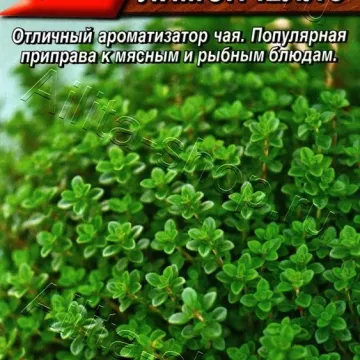


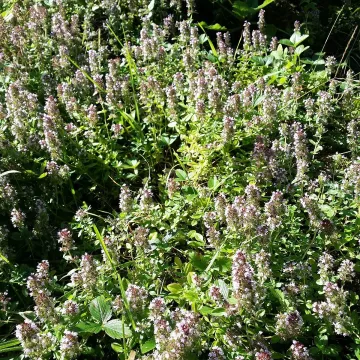


Thyme
When sowing directly in the field, it is crucial to keep the seed depth shallow, typically around 0.5 centimeters, to ensure the sprouts emerge without exhausting their stored energy reserves in the seed.
Transplanting seedlings is often preferred for large-scale operations. Raising seedlings in a greenhouse for 6 to 8 weeks before field establishment ensures a higher survival rate and uniform stand density across the field.
Row spacing is generally maintained at 50-60 centimeters. This provides sufficient room for mechanical cultivation and inter-row weeding, which is vital during the early establishment phase when thyme grows slowly.
Proper field preparation involves eliminating weeds well before sowing, as young thyme plants are poor competitors and can easily be overtaken by invasive grasses or broadleaf weeds.
As a member of the Lamiaceae family, Thyme is a sun-loving plant that requires full exposure to sunlight to maximize the synthesis of essential oils, such as thymol and carvacrol, within its foliage.
The ideal soil for thyme is light, well-draining, and sandy or gravelly in nature. Excellent drainage is non-negotiable, as waterlogged conditions lead to rapid root rot and significant crop losses in commercial plantations.
Thyme thrives in soils with a pH ranging from 6.0 to 7.5. It performs well in relatively nutrient-poor soils, but it benefits from moderate potassium and phosphorus fertilization to support steady growth and essential oil production.
The plant is highly drought-tolerant once established. While it prefers dry conditions, supplemental irrigation during the peak growing season can significantly increase the total biomass yield without compromising quality.
Climatic requirements involve moderate temperatures, although thyme is hardy enough to survive cold winters if protected by snow cover or mulching in regions experiencing frequent sub-zero temperatures.
Thyme productivity is influenced by plant age, soil quality, and management intensity. Yields are generally modest during the first year of production as plants focus on developing a robust root system.
Optimal productivity is typically achieved from the second to the fourth year of cultivation. Under intensive farming conditions, growers can achieve 2 to 5 tonnes of dry herbaceous material per hectare annually.
The number of harvests per season is dictated by the local climate, with two to three cuttings possible in warmer regions. Quick regrowth after cutting is essential for maximizing the annual total yield.
Proper plant density, usually around 150,000 to 200,000 plants per hectare, is crucial for reaching the maximum yield potential. Excessive thinning or overcrowding can negatively impact both plant health and weed suppression.
Economic success in thyme farming is largely determined by the oil content. Therefore, agronomic practices must focus not only on biomass volume but also on the chemical composition of the harvested foliage.
Gray mold, caused by Botrytis cinerea, is a major threat to thyme plantations, especially in humid climates with poor air circulation. It manifests as a fuzzy gray growth on leaves and stems, often leading to plant death.
Root rot caused by Phytophthora or Pythium species is common in soils with poor drainage. This condition leads to wilting and sudden collapse of plants, often requiring the complete removal of the affected area.
Insect pests, including aphids and spider mites, can cause significant damage during hot, dry spells. They suck sap from the tender leaves, which weakens the plant and reduces both the biomass and the essential oil quality.
Cutworms and other soil-borne larvae can devastate young plantations by feeding on the root crowns and stems. Soil monitoring and early detection are essential to implement effective management strategies.
Integrated pest management, including crop rotation every 4-5 years, is the most effective approach to reduce the pressure from soil-borne pathogens and pests without relying solely on chemical pesticides.
The timing of harvest is critical for thyme quality. Collection is ideally performed at the start of full bloom, when the concentration of essential oils is at its peak and the plant is most pharmacologically active.
Harvesting is carried out by cutting the stems 5 to 10 centimeters above the ground. Leaving sufficient vegetative material behind allows the plant to recover quickly and ensures it has enough energy to survive through the winter.
Post-harvest handling must be swift. The cut foliage should be moved to a drying facility immediately to prevent overheating and moisture buildup, which can promote fungal growth and oil degradation.
Drying is conducted at controlled temperatures, usually 35-40 degrees Celsius, in a dark, well-ventilated environment. Direct sunlight must be avoided to prevent the oxidation of aromatic compounds and the loss of chlorophyll.
Once dried to a moisture content of about 10-12 percent, the thyme is processed by stripping the leaves and flowers from the stems, resulting in a high-quality product ready for essential oil distillation or packaging.