
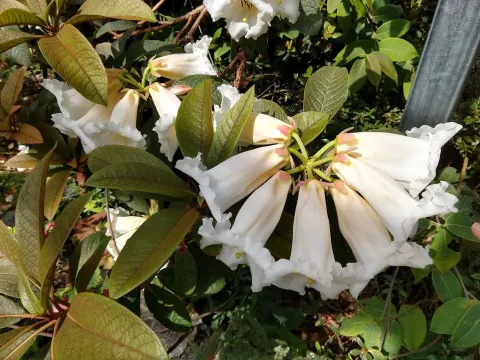
Nuttall's rhododendron
Rhododendron nuttallii
Nuttall's rhododendron (Rhododendron nuttallii) belongs to the Ericaceae family and is known for its exceptionally large, fragrant flowers. Native to the mountain forests of Bhutan, India, and China, it typically grows in high-altitude habitats where the air is consistently moist and cool.
What the section contains
Nuttall's rhododendron
Botanically, this species is an evergreen shrub or a small tree that can reach 3 to 5 meters in height. The leaves are thick, leathery, and dark green, providing a perfect backdrop for the magnificent, trumpet-shaped white or creamy yellow blooms that appear in clusters.
Successful cultivation requires a subtropical climate or a well-controlled greenhouse environment. The species does not tolerate freezing temperatures, making it unsuitable for open-field planting in temperate regions. It thrives in sheltered positions away from drying winds.
Soil requirements are strict: the plant necessitates acidic, well-draining soil rich in organic matter. A pH level between 4.5 and 5.5 is essential for optimal nutrient uptake. Adding pine bark or peat to the planting site helps maintain the required soil structure and acidity.
The agrotechnical management involves careful irrigation with soft water, as minerals in hard water can cause damage to sensitive roots. Fertilization must be performed using special acid-loving plant formulas, avoiding any products containing calcium or lime, which can quickly prove lethal.
The main threats to this species include root rot and Phytophthora, primarily caused by poor drainage and excessive moisture. To mitigate these risks, it is essential to ensure that the root zone is never waterlogged and that the substrate allows for sufficient oxygen circulation.
Pest issues often involve the rhododendron bug and spider mites, which feed on the sap of the foliage. Regular inspection of the undersides of the leaves is critical, as early detection allows for effective control using horticultural oils or systemic insecticides.