
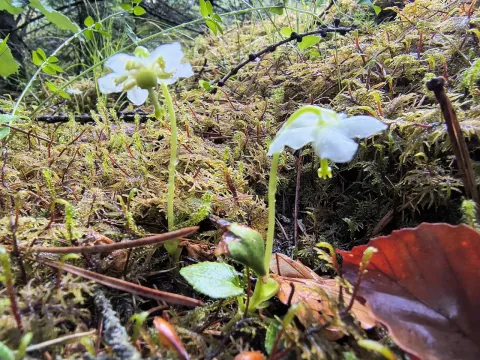
One-flowered wintergreen
Moneses
One-flowered wintergreen (Moneses) is a perennial herbaceous plant belonging to the Ericaceae family. Previously classified under the Pyrolaceae family, it is now accepted as part of the diverse Heath family. This plant is known for its small, compact size, rarely exceeding 15 centimeters in height, making it a subtle inhabitant of the forest floor.
What the section contains

One-flowered wintergreen
Its natural range encompasses the circumpolar boreal forests of the Northern Hemisphere. It thrives in cool, shaded environments where coniferous trees provide a deep layer of leaf litter. The plant is highly specialized and requires specific soil conditions, including acidity and high levels of organic matter to support its life cycle.
Botanically, Moneses is characterized by a basal rosette of evergreen, leathery leaves that remain functional even in winter. The main stem bears a solitary, nodding, white, fragrant flower. This single flower is the plant's most striking feature, giving it its common name and making it easily recognizable in its native habitat.
The plant is obligately mycotrophic, meaning it depends entirely on a symbiotic relationship with soil fungi to obtain nutrients. This biological necessity makes cultivation in agricultural settings or garden beds impossible. Without its specific fungal partner, the plant cannot absorb the necessary nutrients to survive or reproduce.
There is no commercial agricultural use for the One-flowered wintergreen. It is not a crop and has no history of systematic cultivation. Its significance is purely ecological, as it serves as an indicator species for healthy, undisturbed forest ecosystems. Efforts are focused on preserving its natural habitat rather than economic exploitation.
The primary threats to the species are habitat destruction, particularly clear-cutting of old-growth coniferous forests, and forest fragmentation. Because the plant relies on a delicate balance of moisture and fungal networks, any disturbance to the soil surface or the tree canopy creates an environment where it cannot persist.
There are no recorded agricultural pests or diseases for Moneses as it is not an agricultural crop. Potential threats in its wild state include shifts in moisture levels due to climate change, which can inhibit the growth of the necessary fungal symbionts, effectively starving the plant from beneath the soil.