
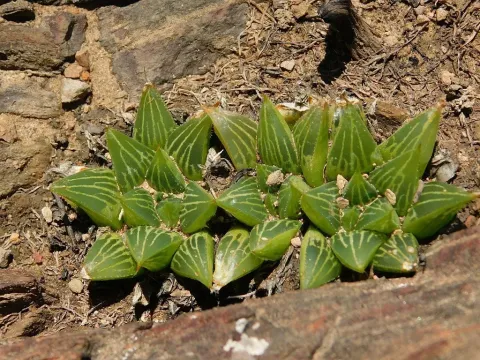
Haworthia
Haworthia Duval
Haworthia is a genus of small succulent plants belonging to the Asphodelaceae family, native to the arid regions of Southern Africa. These plants are characterized by their thick, fleshy leaves arranged in rosettes, often featuring unique patterns or translucent windows.
What the section contains
 Haworthia cymbiformis
 (Haw.) Duval
Haworthia cymbiformis
Haworthia cymbiformis (Haw.) Duval
 Haworthia cymbiformis var. obtusa
Haworthia cymbiformis (Haw.) Duval var. obtusa (Haw.) Baker
Haworthia cymbiformis var. obtusa
Haworthia cymbiformis (Haw.) Duval var. obtusa (Haw.) Baker
 Haworthia magnifica
 Poelln.
Haworthia magnifica
Haworthia magnifica Poelln.
 Haworthia magnifica var. splendens
 J. D. Venter & S. A. Hammer
Haworthia magnifica var. splendens
Haworthia magnifica var. splendens J. D. Venter & S. A. Hammer
 Haworthia maxima
 (Haw.) Duval
Haworthia maxima
Haworthia maxima (Haw.) Duval
 Haworthia mirabilis
 (Haw.) Haw.
Haworthia mirabilis var. badia
Haworthia mirabilis var. badia (Poelln.) M. B. Bayer
Haworthia mirabilis
Haworthia mirabilis (Haw.) Haw.
Haworthia mirabilis var. badia
Haworthia mirabilis var. badia (Poelln.) M. B. Bayer
 Haworthia truncata
 Schönland
Haworthia truncata
Haworthia truncata Schönland
 Haworthia truncata var. maughanii
Haworthia truncata Schönland var. maughanii (Poelln.) B. Fearn
Haworthia truncata var. maughanii
Haworthia truncata Schönland var. maughanii (Poelln.) B. Fearn
 Hybrid of Haworthia mirabilis var. badia and Haworthia magnifica var. splendens
hybrids between Haworthia mirabilis (Haw.) Haw. var. badia (Poelln.) M. B. Bayer and Haworthia magnifica Poelln. var. splendens J. D. Venter & S. A. Hammer
Hybrid of Haworthia mirabilis var. badia and Haworthia magnifica var. splendens
hybrids between Haworthia mirabilis (Haw.) Haw. var. badia (Poelln.) M. B. Bayer and Haworthia magnifica Poelln. var. splendens J. D. Venter & S. A. Hammer
 Hybrids of Haworthia mirabilis and Haworthia magnifica
hybrids between Haworthia mirabilis (Haw.) Haw. and Haworthia magnifica Poelln.
Hybrids of Haworthia mirabilis and Haworthia magnifica
hybrids between Haworthia mirabilis (Haw.) Haw. and Haworthia magnifica Poelln.
Haworthia
Successful cultivation requires a well-draining soil mix specifically designed for succulents, typically composed of potting soil, coarse sand, and perlite. A high-quality drainage system at the bottom of the pot is essential to prevent moisture accumulation around the roots.
Environmental conditions should mimic their native habitat: bright, indirect sunlight is preferred. While they can tolerate some partial shade, too much direct sun can cause the foliage to lose its healthy green color and turn reddish-brown due to physiological stress.
Watering requirements follow the soak-and-dry method. During the active growing season, the substrate should be allowed to dry out completely before the next watering. In the dormant winter months, water application must be significantly reduced to prevent root rot.
Propagation of Haworthia is most effective through the separation of offsets, which emerge around the base of the parent plant. This method ensures that the young plants are identical to the parent and allows for rapid establishment in individual containers.
Common pests affecting Haworthia include mealybugs and spider mites, particularly in indoor environments with low humidity. Regular inspection of the leaves, especially near the base, is necessary to catch infestations early and apply appropriate treatments.
Root rot remains the most significant threat to the health of the plant, usually caused by overwatering or poorly draining soil. To manage this risk, ensure the plant is never left sitting in water and maintain good ventilation around the leaves to discourage fungal growth.