
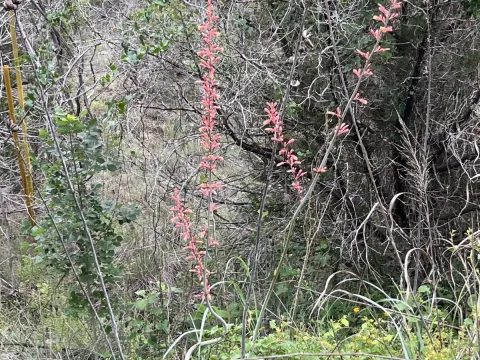
Hesperaloe
Hesperaloe Engelm
Hesperaloe is a genus of perennial evergreen plants belonging to the family Asparagaceae. Despite its appearance, which is often compared to yucca or agave, it constitutes a unique group of plants adapted specifically to arid climates.
What the section contains


Hesperaloe
The native range of Hesperaloe includes the Chihuahuan Desert and surrounding regions of Texas and Mexico. These plants are uniquely evolved to survive in habitats with rocky soils and high solar radiation levels.
The primary requirement for Hesperaloe is excellent drainage. The soil should be gritty, sandy, or gravelly to prevent any water retention around the roots. Heavy clay soils are unsuitable and typically lead to root death.
The plant is highly drought-tolerant and thrives under full sun. It performs well in xeriscaping projects because it requires little to no irrigation once it has become established in the landscape.
Climate tolerance varies by species, but generally, Hesperaloe can withstand temperatures as low as -15 degrees Celsius. It is remarkably resilient to heat, making it an ideal choice for hot, dry regions.
Propagation of Hesperaloe can be achieved through seeds or by dividing the offsets (pups) that develop around the base of the parent plant. Division is the most popular method for fast results.
When propagating via division, the offsets must be carefully removed and allowed to dry or callus for a few days before replanting in a fresh, well-draining substrate to prevent fungal infections.
Seed germination requires warm, consistent temperatures and light, as seeds should not be buried deeply. A sandy, fast-draining propagation mix is essential for the initial development of young seedlings.
Cultivation practices involve minimal intervention. Fertilizer usage should be kept to a minimum, focusing on low-nitrogen formulas applied only during the active growing season in spring or early summer.
In terms of agricultural and industrial use, Hesperaloe is gaining interest for its fibrous leaves, which provide strong, durable fibers. It is also a staple in sustainable, low-water landscaping design.
Hesperaloe is generally resistant to most pests and diseases. The most significant threat to its health is moisture-related issues, specifically rot caused by poor soil drainage or excessive rainfall.
Common insect pests include scale insects and mealybugs. These small insects tend to congregate at the base of the leaves where moisture can be trapped, feeding on the plant's sap and reducing its vigor.
Fungal infections, such as leaf spot, can occur in environments with high humidity and poor airflow. Proper spacing between plants is critical to allow for adequate ventilation and to keep the foliage dry.
Prevention involves monitoring for early signs of infestation and ensuring that the base of the plant remains clean of decaying organic matter or debris that could host fungal spores or pests.
In case of severe infestation, targeted horticultural soaps or systemic insecticides may be used, although natural predators are often sufficient to manage pest populations in open-field settings.