
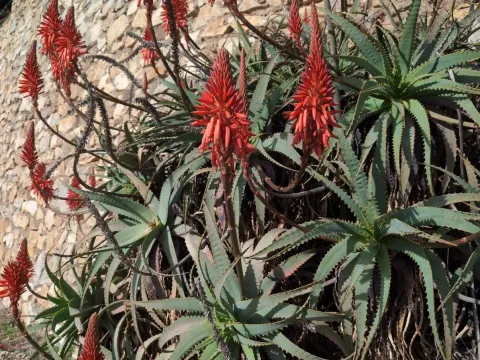
Aloe
Aloe L.
Aloe (Aloe L.) is a perennial succulent plant belonging to the Asphodelaceae family. Native to arid regions of Africa and the Arabian Peninsula, this crop has evolved unique biological mechanisms to store water in its thick, fleshy leaves to survive drought.
What the section contains
 Aloe aculeata
 Pole-Evans
Aloe aculeata
Aloe aculeata Pole-Evans
 Aloe arborescens
 Mill. x Aloe humilis (L.) Mill.
Aloe arborescens
Aloe arborescens Mill. x Aloe humilis (L.) Mill.
 Aloe arborescens
 Mill.
Aloe arborescens
Aloe arborescens Mill. x Aloe vera (L.) Burm. f.
Aloe arborescens
Aloe arborescens Mill.
Aloe arborescens
Aloe arborescens Mill. x Aloe vera (L.) Burm. f.
 Aloe bakeri
 Scott-Elliot
Aloe bakeri
Aloe bakeri Scott-Elliot
 Aloe bakeri × Aloe glauca
Aloe bakeri Scott-Elliot x A. glauca Mill.
Aloe bakeri × Aloe glauca
Aloe bakeri Scott-Elliot x A. glauca Mill.
 Aloe chabaudii
 Schönland
Aloe chabaudii
Aloe chabaudii Schönland
 Aloe chabaudii x Aloe marlothii hybrid
Aloe chabaudii x Aloe marlothii
Aloe chabaudii x Aloe marlothii hybrid
Aloe chabaudii x Aloe marlothii
 Aloe descoingsii
 Reynolds
Aloe descoingsii
Aloe descoingsii Reynolds
 Aloe descoingsii x A. haworthioides
Aloe descoingsii Reynolds x A. haworthioides Baker
Aloe descoingsii x A. haworthioides
Aloe descoingsii Reynolds x A. haworthioides Baker
 Aloe haworthioides
 Baker
Aloe haworthioides
Aloe haworthioides Baker
 Aloe humilis
 (L.) Mill.
Aloe humilis
Aloe humilis (L.) Mill.
 Aloe humilis and Aloe vera hybrid
Aloe humilis (L.) Mill. x Aloe vera (L.) Burm. f.
Aloe humilis and Aloe vera hybrid
Aloe humilis (L.) Mill. x Aloe vera (L.) Burm. f.
 Aloe marlothii
 A. Berger
Aloe marlothii
Aloe marlothii A. Berger
 Aloe perfoliata
 L.
Aloe perfoliata
Aloe perfoliata L.
 Aloe rauhii
 Reynolds
Aloe rauhii
Aloe rauhii Reynolds
 Aloe vera
 (L.) Burm. f.
Aloe vera
Aloe vera (L.) Burm. f.
 Black-spined Aloe
Aloe melanacantha A. Berger
Black-spined Aloe
Aloe melanacantha A. Berger
 Coral aloe
Aloe striata Haw.
Coral aloe
Aloe striata Haw.
 Glaucous aloe
Aloe glauca Mill.
Glaucous aloe
Aloe glauca Mill.
 Tiger Aloe
Aloe variegata L.
Tiger Aloe
Aloe variegata L.
Aloe
The crop requires bright, direct sunlight and well-drained, sandy or loamy soils. Proper soil aeration is crucial to prevent root rot, as the plant is highly sensitive to waterlogged environments and excessive moisture in the root zone.
Optimal growth occurs in temperatures ranging from 20 to 30 degrees Celsius. Because aloe is non-frost tolerant, commercial plantations in non-tropical zones must be maintained in greenhouses to ensure consistent year-round development.
Botanically, aloe is characterized by its rosette growth habit and the presence of parenchyma tissue inside the leaves, which contains the valuable gel used in various industrial applications. Proper plant spacing is essential to ensure adequate airflow and light penetration.
Commercially, aloe is extensively used in the pharmaceutical, cosmetic, and food industries. It is harvested for its inner gel, which is renowned for its anti-inflammatory, moisturizing, and wound-healing properties, making it a high-value agricultural commodity.
The primary threats to aloe production are fungal infections such as root rot and leaf spot, which are frequently triggered by improper irrigation practices. Maintaining a dry environment around the crown of the plant is vital for long-term health.
Common pests include mealybugs, scale insects, and spider mites. These pests typically congregate in the leaf axils or on the undersides of the foliage, extracting sap and weakening the plant's structural integrity over time.
Integrated Pest Management (IPM) is recommended for commercial aloe farms to reduce reliance on chemicals. This includes regular field scouting, biological control agents, and maintaining strict sanitation protocols for all equipment used.
Nutritional deficiencies can also make plants more susceptible to secondary infections. Ensuring a balanced fertilization regime, particularly avoiding excessive nitrogen, helps maintain the natural resistance of the aloe plants.
Proper harvest handling is also a safety measure. Making clean, sharp cuts minimizes the risk of pathogens entering the plant tissue, which is essential for maintaining the quality and shelf-life of the harvested leaves.