
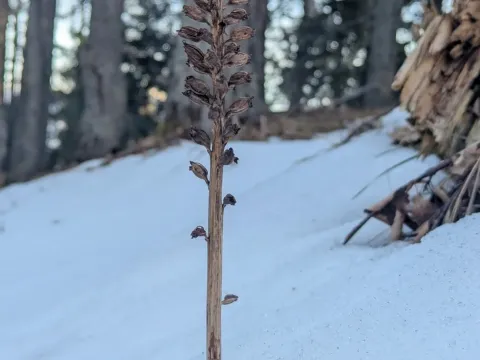
Bird's-nest orchid
Neottia
Neottia, commonly known as the Bird's-nest orchid, belongs to the Orchidaceae family. It is a genus of achlorophyllous plants that obtain energy through mycoheterotrophy rather than photosynthesis.
What the section contains
 Bird's-nest orchid
Neottia nidus-avis
Bird's-nest orchid
Neottia nidus-avis
 Broad-leaved bird's-nest
Neottia convallarioides
Broad-leaved bird's-nest
Neottia convallarioides
 Common Twayblade
Neottia ovata
Common Twayblade
Neottia ovata
 Lesser twayblade
Neottia cordata
Lesser twayblade
Neottia cordata
 Neottia acuminata
Neottia acuminata
Neottia acuminata
 Neottia auriculata
Neottia auriculata
Neottia auriculata
 Neottia banksiana
Neottia banksiana
Neottia banksiana
 Neottia bifolia
Neottia chandrae
Neottia chandrae
Neottia listeroides
Neottia listeroides
Neottia bifolia
Neottia bifolia
Neottia chandrae
Neottia chandrae
Neottia listeroides
Neottia listeroides
 Neottia smallii
Neottia smallii
Neottia smallii
 Northern bird's-nest orchid
Neottia borealis
Northern bird's-nest orchid
Neottia borealis
Bird's-nest orchid
The plant possesses a dense mass of short, brittle roots that resemble a bird's nest, which serves as the primary organ for nutrient exchange with mycorrhizal fungi found in the soil.
Geographically, Neottia is distributed across temperate regions of Europe and Asia. It thrives in deeply shaded environments, typically found in broad-leaved or mixed deciduous forests with rich organic soil.
From a botanical standpoint, the plant is characterized by a brownish or yellowish stem and small, inconspicuous flowers. It lacks green leaves, as it does not produce its own food through sunlight.
There is no commercial agriculture for Neottia because it cannot be cultivated like standard crops. Its growth is strictly dependent on the presence of specific fungal partners and stable forest soil conditions.
The primary threats to the species include habitat destruction, deforestation, and soil disturbance. Because the plant relies on a delicate fungal balance, any change in the forest floor ecosystem leads to its rapid decline.
Environmental pollutants and nitrogen fertilization in adjacent agricultural areas can disrupt the mycorrhizal connection, which is lethal for these specialized orchids. Therefore, preservation is possible only through habitat protection.