
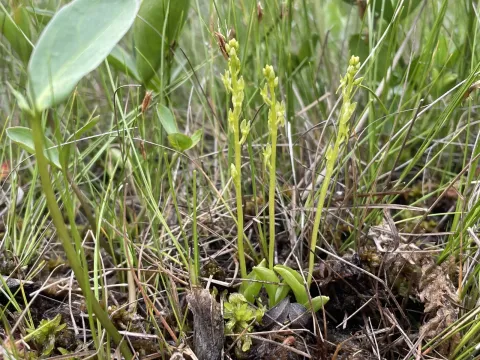
Bog orchid
Hammarbya
The bog orchid (Hammarbya paludosa) is a unique member of the Orchidaceae family. It is not an agricultural crop but a highly specialized wild plant known for its small size and rarity.
What the section contains

Bog orchid
Its natural habitat consists primarily of bogs, peatlands, and wet tundra. The species requires acidic environments dominated by sphagnum moss to thrive and reproduce effectively.
Botanically, it features a small pseudobulb partially buried in moss, with few leaves and a raceme of tiny, greenish-yellow flowers. It is one of the smallest orchids found in its native regions.
The distribution of Hammarbya paludosa spans the northern hemisphere, including parts of Europe, Asia, and North America, where cold and wet climates are consistent throughout the year.
The plant demonstrates a unique vegetative reproduction mechanism through bulbils formed on the leaf tips, which detach and grow into new individual plants in the surrounding moss.
The main threat to the bog orchid is the loss of habitat due to drainage, wetland reclamation, and general land development projects that alter hydrological systems.
Eutrophication caused by agricultural runoff is extremely detrimental to the species, as it requires nutrient-poor, clean water to compete with other bog vegetation.
Climate change poses a significant risk by altering precipitation patterns, which threatens the stability of the water table essential for the survival of this moisture-dependent plant.
Unlike commercial crops, there are no documented pathogens or pests that require chemical control, as preservation of the ecosystem is the only way to manage the species.
Because of its fragility and reliance on specific micro-habitats, the bog orchid is protected under various conservation laws in many of its native countries.