
Lesser twayblade
Neottia cordata
Description
Growing requirements
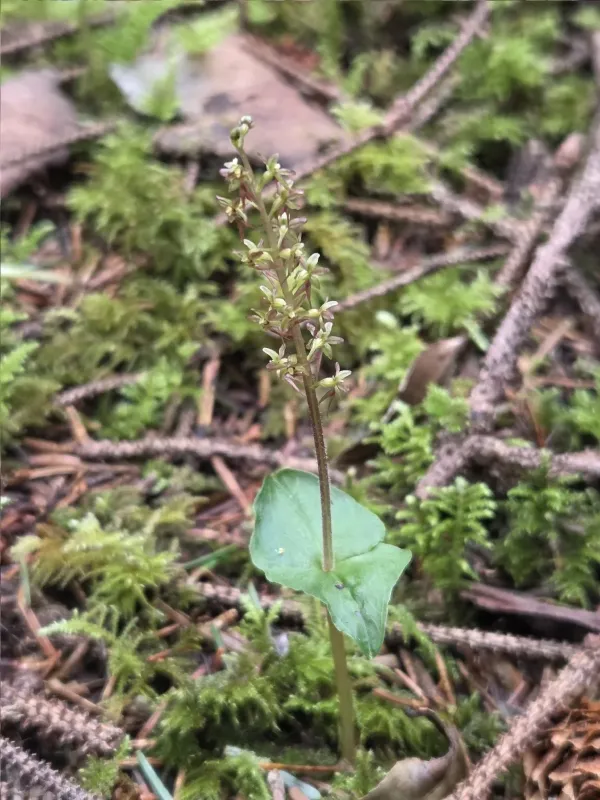
The Lesser twayblade (Neottia cordata) is a small perennial herbaceous plant belonging to the Orchid family (Orchidaceae). This species is well-known for its delicate nature and complex symbiotic relationship with soil fungi, which is vital for its nutrient uptake.
Geographically, the species is found throughout the northern regions of the Holarctic realm. It typically inhabits moist coniferous forests, preferring areas with deep moss cover and high humidity, which provide the stable conditions necessary for its survival.
Botanically, the plant is characterized by two small heart-shaped leaves situated at the base of the stem. Its root system is quite fragile and depends heavily on specific mycorrhizal associations, making the species unsuitable for commercial cultivation or traditional agricultural practices.
The species has very strict environmental requirements, including constant high humidity and protection from direct sunlight. It thrives only in undisturbed ecosystems where the microclimate remains constant throughout the entire growing season.
Regarding its economic value, the plant has no industrial application. As a rare and often protected species in many countries, it serves as a valuable subject for botanical studies and ecological research rather than as a commercial crop.
Main diseases and pests
The primary threats to the species are anthropogenic activities, such as deforestation and the drainage of wetlands. Such actions destroy the forest understory, which is essential for the plant's survival and its symbiotic fungal partners.
Pests typical of woodland environments, such as slugs and various insects, may damage the leaves and flowers of the plant. These injuries can severely limit the plant's ability to reproduce and maintain its local population numbers.
Disease outbreaks in this species are often triggered by unstable environmental conditions, such as sudden shifts in humidity or temperature. Since the plant is not cultivated, there are no established chemical or mechanical control measures to mitigate fungal or bacterial infections.
Climate change poses a significant long-term risk to the species, as it relies on very specific moisture levels in coniferous forest floors. As these environments change or shrink, the habitat available for the Lesser twayblade becomes increasingly limited.
Effective management and conservation of this orchid require the preservation of old-growth coniferous forests. Protecting these sensitive habitats is the only way to ensure the long-term survival of the species within its natural distribution range.