
Broad-leaved bird's-nest
Neottia convallarioides
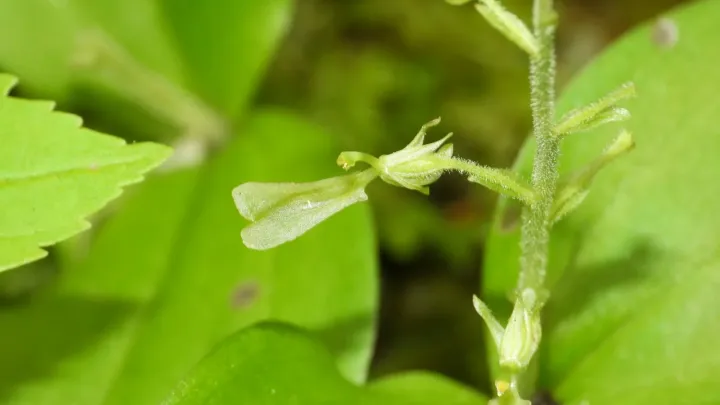
Description
Growing requirements
Broad-leaved bird's-nest (Neottia convallarioides) is a perennial herbaceous plant belonging to the Orchidaceae family. It is not cultivated as an agricultural crop but is a significant species in forest botany, representing the complex ecological relationships found in temperate woodland biomes.
The species is native to the Northern Hemisphere, where it thrives in moist, shaded environments, typically under dense canopy cover. Its life cycle is heavily dependent on specific soil fungi, as the plant relies on myco-heterotrophic relationships to obtain essential nutrients, making it impossible to cultivate in standard soil conditions.
Botanically, the plant is distinguished by its fleshy rhizomes and broad, oval-shaped leaves that bear a structural resemblance to the lily-of-the-valley. The inflorescence consists of a loose raceme of small, pale flowers, which are characteristic of the Neottia genus and are adapted for specific pollinator interactions.
The environmental requirements include high humidity levels and a stable cool climate. It requires specific forest floor conditions characterized by high organic matter content and a neutral to slightly acidic pH. Efforts to transplant or commercialize this species have consistently failed due to its specialized ecological needs.
The primary threats to the species involve habitat loss, deforestation, and soil compaction which disrupts the delicate fungal networks in the root zone. While there are no agricultural pests or diseases that target this plant in a farm setting, it remains vulnerable to invasive plant species and changing climate patterns that affect its restricted niche.