
Bird's-nest orchid
Neottia nidus-avis
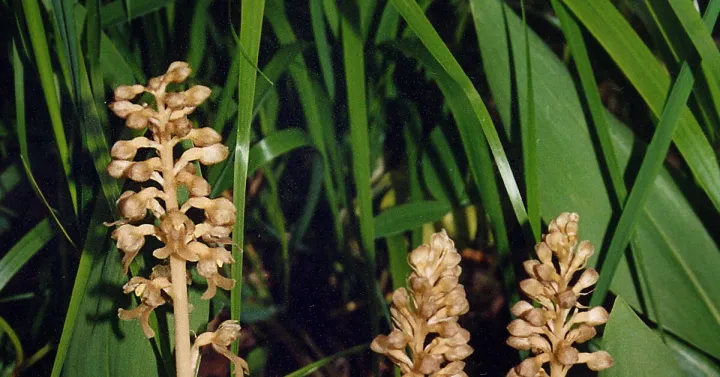
Description
Growing requirements
The Bird's-nest orchid is a perennial achlorophyllous plant belonging to the Orchidaceae family. Unlike conventional crops, it lacks chlorophyll and cannot perform photosynthesis.
The plant survives entirely as a mycoheterotroph, obtaining all its nutrients from fungi of the genus Rhizoctonia. These fungi form a complex network with tree roots, transferring sugars and nutrients to the orchid.
Ideal conditions for this species are found in deep, shaded forests with rich humus soils. It requires high humidity and a consistent environment to maintain the delicate balance of its mycorrhizal relationship.
Its natural range includes Europe, the Caucasus, and parts of Western Asia. It is typically associated with beech or oak forests where the leaf litter provides a stable environment for its host fungi.
Because it relies on these specific fungal hosts, it is impossible to cultivate this plant using traditional agricultural techniques. It has no agricultural usage and is protected in many jurisdictions.
Main diseases and pests
The primary threat to the Bird's-nest orchid is habitat destruction. Deforestation or changing the composition of the forest floor disrupts the essential fungal network, leading to rapid extinction of the local population.
The plant is susceptible to various fungal pathogens that can affect its underground stem or rhizome. Additionally, specific insect pests may target the flowering spikes, reducing the plant's ability to produce seeds.
Soil disturbance caused by mechanical agricultural or forestry operations is lethal. Even minor compaction of the soil can damage the rhizome and the delicate fungal hyphae needed for survival.
Climate change and prolonged drought conditions can negatively affect the moist forest habitats. Reduced moisture leads to a decline in fungal activity, which directly results in the plant's starvation.
As a sensitive wild species, there are no approved pesticides or fertilizers. Conservation efforts focus exclusively on protecting the integrity of its native forest habitat and avoiding soil disturbance.