
Northern bird's-nest orchid
Neottia borealis
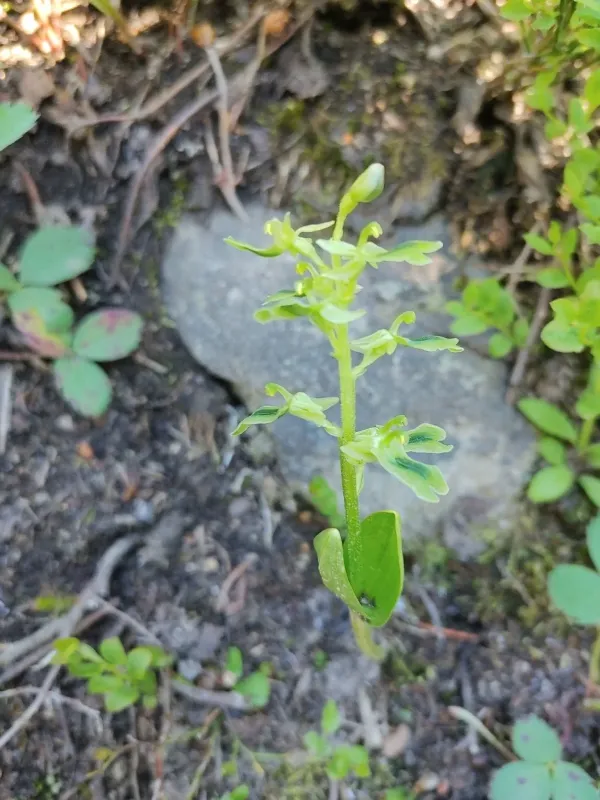
Description
Growing requirements
The Northern bird's-nest orchid (Neottia borealis) is a perennial herbaceous plant belonging to the Orchidaceae family. It is a strictly mycoheterotrophic species, meaning it lacks chlorophyll and cannot perform photosynthesis, relying entirely on symbiotic soil fungi for its carbon and nutrient supply.
The distribution of this orchid covers boreal regions across the Northern Hemisphere. It thrives in dense coniferous or mixed forests with deep organic litter layers, which are essential for supporting the fungal networks necessary for the plant's survival.
Botanically, the species is distinctive for its lack of green pigmentation. Its stem is pale yellow to brownish, covered with scale-like leaves. The flowering spike consists of several small, subtle flowers that are often overlooked by casual observers in the forest floor environment.
Requirements for the habitat are extremely specific. The orchid requires high atmospheric humidity and undisturbed soil conditions to maintain the delicate balance with its fungal partner. Any significant shift in environmental conditions typically results in the local disappearance of the plant.
This species is not an agricultural crop and has no commercial usage. Its primary value is ecological, acting as an indicator species for old-growth forest health and a vital component of northern biodiversity that requires protected status rather than cultivation.
Main diseases and pests
The primary threats to Neottia borealis include habitat loss and fragmentation caused by logging, industrial development, and road construction, which disrupt the integrity of forest ecosystems.
Drainage of wetlands or changes in local hydrology can lead to the death of the specific fungi upon which the orchid relies, subsequently causing the death of the plant itself, even if the plant's immediate area appears physically intact.
Agricultural and silvicultural practices involving the use of chemicals, particularly soil-active fungicides, are lethal to the species because they disrupt the essential mycorrhizal interactions required for the plant to obtain nutrients.
The species is also susceptible to disturbance by trampling, as the forest floor vegetation is very sensitive to compaction and structural changes, which can easily damage the root and fungal networks beneath.
Given its rarity, the Northern bird's-nest orchid is listed in various conservation registries. Effective protection requires the strict preservation of its natural forest habitat and the avoidance of any human-induced changes to the soil microbiome.