
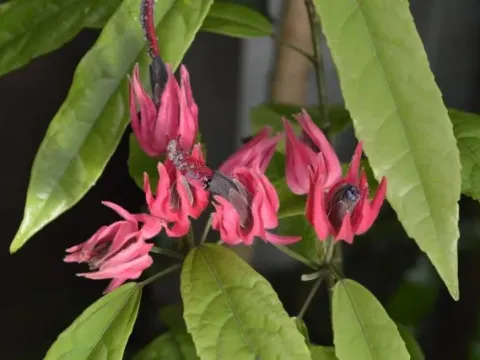
Pavonia
Pavonia
Sowing of Pavonia (Pavonia) requires well-warmed soil, so field operations usually begin in late spring once the risk of late frosts has passed. The optimal soil temperature at the sowing depth should be at least 15–18 degrees Celsius.
What the section contains
 Bahama swampbush
Pavonia bahamensis
Bahama swampbush
Pavonia bahamensis
 Brazilian Candles
Pavonia multiflora
Brazilian Candles
Pavonia multiflora
 Ceylon pavonia
Pavonia zeylanica
Ceylon pavonia
Pavonia zeylanica
 Pavonia arabica
Pavonia arabica
Pavonia arabica
 Pavonia burchellii
Pavonia burchellii
Pavonia burchellii
 Pavonia cancellata
Pavonia cancellata
Pavonia cancellata
 Pavonia communis
Pavonia communis
Pavonia communis
 Pavonia fruticosa
Pavonia fruticosa
Pavonia fruticosa
 Pavonia humifusa
Pavonia humifusa
Pavonia humifusa
 Pavonia paludicola
Pavonia paniculata
Pavonia paniculata
Pavonia paludicola
Pavonia paludicola
Pavonia paniculata
Pavonia paniculata
 Pavonia praemorsa
Pavonia praemorsa
Pavonia praemorsa
 Pavonia repanda
Pavonia repanda
Pavonia repanda
 Pavonia rosea
Pavonia rosea
Pavonia rosea
 Pavonia schiedeana
Pavonia schiedeana
Pavonia schiedeana
 Pavonia senegalensis
Pavonia senegalensis
Pavonia senegalensis
 Pavonia sepium
Pavonia sidaefolia
Pavonia sidaefolia
Pavonia sepium
Pavonia sepium
Pavonia sidaefolia
Pavonia sidaefolia
 Pavonia spinifex
Pavonia spinifex
Pavonia spinifex
 Pavonia triloba
Pavonia triloba
Pavonia triloba
 Pavonia varians
Pavonia varians
Pavonia varians
Pavonia
Seeds are sown in rows with spacing that allows for efficient mechanical cultivation. The seeding rate depends on the intended use: for high-quality bast fiber production, planting density should be higher than when growing for seed purposes.
An essential stage is thorough seedbed preparation; the soil must be well-loosened and free of weeds. Pavonia is sensitive to planting depth, with the optimal depth for seed coverage being 2–3 centimeters.
After sowing, rolling the field is recommended to ensure better contact between seeds and soil moisture. Under favorable conditions, uniform emergence occurs 10–14 days after sowing.
In regions with shorter growing seasons, Pavonia can be grown via seedlings, which helps to accelerate maturation and increase total biomass yield.
Pavonia is a heat-loving plant of the Malvaceae family that requires a significant amount of sunlight for full development. Ideal climatic conditions for the crop include tropical and subtropical zones with high humidity.
The crop has high requirements for soil fertility: it thrives best on loose, well-drained loams or chernozems with a neutral pH. Waterlogging is highly undesirable as it triggers root rot.
Ensuring regular irrigation is particularly important in the first half of the growing season when the plant actively increases stem biomass. Water deficit during this period significantly reduces the quality and quantity of the harvested bast fiber.
The plant is responsive to the application of organic and mineral fertilizers, especially nitrogen, which stimulates the growth of vegetative organs. Split application of fertilizers throughout the season is recommended.
- High light exposure for the plot.
- Protection from strong, cold winds.
- Regular inter-row cultivation for root aeration.
- Maintenance of an optimal pH level (6.0–7.5).
The economic value of Pavonia lies in its stems, from which a strong plant fiber is obtained, comparable in properties to jute or kenaf. Dry mass yield depends on the intensity of agronomic care provided.
With proper cultivation technology, a significant volume of raw material suitable for the textile and pulp-and-paper industries can be harvested per hectare. Stem height under favorable conditions reaches 1.5–2 meters.
Harvesting is performed at the beginning of the flowering phase, as it is during this period that the fiber possesses maximum strength and elasticity. Delaying the harvest leads to stem coarsening and reduced raw material quality.
Besides the stems, the seeds hold some value and can be used for subsequent propagation or as animal feed after appropriate processing.
The green mass yield of Pavonia in experimental fields shows great potential for industrial cultivation in suitable climatic zones.
Pavonia, like other members of the Malvaceae family, can be attacked by specific pests, among which spider mites and various aphid species are the most common. They suck sap from the leaves, slowing down plant growth.
Leaf and stem spot diseases caused by fungal pathogens are prevalent. In conditions of high humidity and stagnant air, the risk of infection increases significantly.
To combat pests, broad-spectrum insecticides are used, though preference is given to biological control methods and crop rotation. Preventing crop overcrowding is essential.
Root rot poses a serious threat in heavy, waterlogged soils. This can be prevented through proper soil preparation and the organization of quality drainage in the fields.
Timely weeding is also critical, as weeds act as reservoirs for infections and pests that can migrate to Pavonia plantations.
Pavonia harvesting is carried out mechanically using specialized forage harvesters or mowers. It is important to maintain stem integrity as much as possible for subsequent fiber processing.
Immediately after cutting, the raw material undergoes primary processing: leaf removal and length sorting. To obtain high-quality fiber, the stems are subjected to a retting process—prolonged water soaking to break down pectin substances.
After retting, the fiber is separated from the wooden core (shiv), washed, and dried in the open air or in drying facilities. Adherence to temperature regimes during drying prevents damage to the fiber structure.
The finished fiber is pressed into bales for easy transportation to processing plants. It is crucial that the moisture content of the finished raw material does not exceed acceptable limits to avoid mold growth during storage.
Harvesting efficiency depends directly on crop uniformity and the absence of weeds, making proper field preparation before the season the key to a successful harvest.