
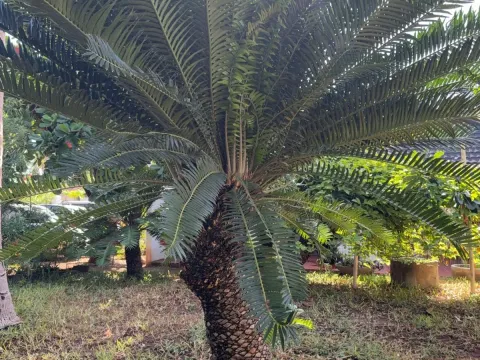
Encephalartos
Encephalartos
Encephalartos is a genus of cycads belonging to the Zamiaceae family. These plants are considered living fossils, with an evolutionary history dating back millions of years. They are native to the African continent, ranging from tropical forests to arid bushveld environments.
What the section contains
 Dyer's cycad
Encephalartos dyerianus
Dyer's cycad
Encephalartos dyerianus
 Encephalartos altensteinii
Encephalartos altensteinii
Encephalartos altensteinii
 Encephalartos cupidus
Encephalartos cupidus
Encephalartos cupidus
 Encephalartos dolomiticus
Encephalartos dolomiticus
Encephalartos dolomiticus
 Encephalartos eugene-maraisii
Encephalartos eugene-maraisii
Encephalartos eugene-maraisii
 Encephalartos hildebrandtii
Encephalartos hildebrandtii
Encephalartos hildebrandtii
 Encephalartos hirsutus
Encephalartos hirsutus
Encephalartos hirsutus
 Encephalartos horridus
Encephalartos horridus
Encephalartos horridus
 Encephalartos inopinus
Encephalartos inopinus
Encephalartos inopinus
 Encephalartos ituriensis
Encephalartos ituriensis
Encephalartos ituriensis
 Encephalartos laurentianus
Encephalartos laurentianus
Encephalartos laurentianus
 Encephalartos lebomboensis
Encephalartos lebomboensis
Encephalartos lebomboensis
 Encephalartos lehmannii
Encephalartos lehmannii
Encephalartos lehmannii
 Encephalartos septentrionalis
Encephalartos septentrionalis
Encephalartos septentrionalis
 Encephalartos transvenosus
Encephalartos transvenosus
Encephalartos transvenosus
 Encephalartos villosus
Encephalartos villosus
Encephalartos villosus
 Encephalartos whitelockii
Encephalartos whitelockii
Encephalartos whitelockii
 Middelburg cycad
Encephalartos middelburgensis
Middelburg cycad
Encephalartos middelburgensis
 Mountain Cycad
Encephalartos nubimontanus
Mountain Cycad
Encephalartos nubimontanus
 Wood's cycad
Encephalartos woodii
Wood's cycad
Encephalartos woodii
Encephalartos
The botanical structure of Encephalartos includes a robust, woody trunk and a crown of stiff, pinnate leaves. Because they are dioecious plants, fertilization requires the presence of both male and female specimens, making propagation a complex and specialized task in a nursery setting.
Cultivation requirements involve providing well-drained, porous soil and sufficient light levels. They are highly susceptible to root decay, necessitating the use of specialized potting mixes that prevent waterlogging and facilitate air circulation around the root system.
Climate management is crucial for the successful growth of Encephalartos. As heat-loving plants, they require protection from frost and cold drafts. In non-native environments, they are grown almost exclusively under climate-controlled conditions in greenhouses or conservatories.
Economic use of Encephalartos is primarily focused on the high-end ornamental trade and conservation-oriented botanical projects. Due to their slow growth rate and protected status in the wild, cultivation is strictly regulated by international standards and environmental laws.
Common pests affecting Encephalartos include scale insects and mealybugs. These pests attach to the hard leaf surfaces, and if left untreated, they can significantly reduce the vitality of the plant by draining its sap and promoting secondary fungal growth.
Root rot is the most common and dangerous disease, often triggered by overwatering or poor drainage. Managing soil moisture is the primary preventative measure, supplemented by the occasional application of fungicides to the soil if environmental conditions are humid.