

Reference · Crops
Camellia
Camellia L.
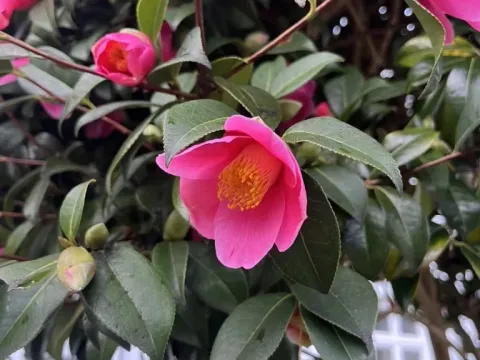
Camellia (Camellia L.) is a genus of flowering plants in the family Theaceae. Among its various species, Camellia sinensis is the most economically significant, serving as the primary source for global tea production.
25
items
What the section contains
 Camellia azalea
 C. F. Wei
Camellia azalea
Camellia azalea C. F. Wei
 Camellia azalea and Camellia japonica hybrids
hybrids between Camellia azalea C. F. Wei and Camellia japonica L.
Camellia azalea x Camellia reticulata
Camellia azalea C. F. Wei x Camellia reticulata Lindl.
Camellia azalea and Camellia japonica hybrids
hybrids between Camellia azalea C. F. Wei and Camellia japonica L.
Camellia azalea x Camellia reticulata
Camellia azalea C. F. Wei x Camellia reticulata Lindl.
 Camellia dormoyana
 (Pierre ex Laness) Sealy
Camellia dormoyana
Camellia dormoyana (Pierre ex Laness) Sealy
 Camellia euphlebia
 Merr.ex Sealy
Camellia hamyenensis
Camellia hamyenensis Ninh & Le
Camellia euphlebia
Camellia euphlebia Merr.ex Sealy
Camellia hamyenensis
Camellia hamyenensis Ninh & Le
 Camellia japonica
 L.
Camellia japonica
Camellia japonica L.
 Camellia luongii
 Ninh & Le.
Camellia luongii
Camellia luongii Ninh & Le.
 Camellia oleifera
 C. Abel
Camellia oleifera
Camellia oleifera C. Abel
 Camellia phanii
 Hakoda et Ninh
Camellia phanii
Camellia phanii Hakoda et Ninh
 Camellia pleurocarpa
 (Gagnep.) Sealy
Camellia pleurocarpa
Camellia pleurocarpa (Gagnep.) Sealy
 Camellia rosthorniana
 Hand.-Mazz.
Camellia rosthorniana
Camellia rosthorniana Hand.-Mazz.
 Camellia taliensis
 (W. W. Sm.) Melch.
Camellia taliensis
Camellia taliensis (W. W. Sm.) Melch.
 Camellia taliensis x Camellia sinensis hybrid
Camellia taliensis x C. sinensis
Camellia taliensis x Camellia sinensis hybrid
Camellia taliensis x C. sinensis
 Camellia tsaii
 Hu
Camellia tsaii
Camellia tsaii Hu
 Camellia tuyenquangensis
 D.V. Luong, N. N. H. Le & N. Tran.
Camellia tuyenquangensis
Camellia tuyenquangensis D.V. Luong, N. N. H. Le & N. Tran.
 Golden Camellia
Camellia chrysantha (Hu) Tuyama
Golden Camellia
Camellia chrysantha (Hu) Tuyama
 Golden-flowered Camellia
Camellia petelotii (Merr.) Sealy
Oilseed camellia hybrid
Camellia oleifera C. Abel x Camellia sasanqua Thunb.
Golden-flowered Camellia
Camellia petelotii (Merr.) Sealy
Oilseed camellia hybrid
Camellia oleifera C. Abel x Camellia sasanqua Thunb.
 Reticulated camellia
Camellia reticulata Lindl.
Reticulated camellia
Camellia reticulata Lindl.
 Salween camellia
Camellia saluenensis Stapf ex Bean
Salween camellia
Camellia saluenensis Stapf ex Bean
 Sasanqua camellia
Camellia sasanqua Thunb.
Sasanqua camellia
Camellia sasanqua Thunb.
 Tea plant
Camellia sinensis (L.) Kuntze
Tea plant
Camellia sinensis (L.) Kuntze
 Thick-leaved Camellia
Camellia crassiphylla Ninh & Hakoda
Thick-leaved Camellia
Camellia crassiphylla Ninh & Hakoda
 Williams Camellia
Camellia x williamsii W. W. Sm.
Williams Camellia
Camellia x williamsii W. W. Sm.
Marketplace
Products in this section · 1
Camellia
This crop thrives in humid, subtropical climates with mild temperatures. It is highly sensitive to extreme frost, which limits its commercial cultivation to specific regions that provide consistent environmental conditions throughout the year.
The ideal soil for Camellias is acidic, with a pH range of 4.5 to 5.5. Soil aeration and drainage are critical, as the roots are highly susceptible to rot if they remain waterlogged for extended periods.
Cultivation requires regular fertilization to ensure vigorous leaf growth. A balanced supply of nitrogen is particularly important during the active growing season to support the development of new, high-quality foliage.
Camellias perform best in locations with high atmospheric humidity. They dislike excessive direct exposure to harsh, drying winds and often benefit from being grown in areas with partial shade or consistent cloud cover.
The yield of a Camellia plantation is determined by plant density, age, and maintenance practices. A typical commercial tea garden reaches its peak production capacity several years after establishment.
Harvesting of the leaves generally begins once the plants have established a strong root system and a sufficient canopy. In intensive agricultural systems, yields can reach several tons of fresh leaf per hectare annually.
In addition to leaf production, Camellia seeds are harvested for oil extraction. The oil obtained from specific species, such as Camellia oleifera, is highly valued for its culinary and cosmetic properties.
Pruning is an essential technique for maintaining yield. Regular shearing encourages the development of new shoots and keeps the plants at a manageable height for efficient harvesting operations.
Altitude often correlates with the quality of the harvest. High-altitude plantations often yield leaves with superior aroma and flavor profiles, making them highly sought after in international markets.
Common threats to Camellia crops include fungal infections like anthracnose and petal blight. These diseases are often exacerbated by poor air circulation and excessive moisture within the plantation rows.
Pest pressure often comes from insects such as aphids, mites, and scale insects. These pests feed on the tender young leaves, reducing both the aesthetic and commercial value of the harvested material.
Effective management involves an integrated pest management (IPM) approach. This includes biological control methods, regular monitoring, and the use of targeted treatments that minimize impact on beneficial insects.
Sanitation practices, such as the removal of deadwood and infected leaves, are vital to preventing the spread of diseases. Keeping the plantation weed-free also reduces the reservoir for various pests.
Strategic planting density is crucial to ensure good airflow. Proper spacing prevents the microclimate from becoming too humid, which in turn reduces the likelihood of severe fungal outbreaks.