

Description
How to tell it apart
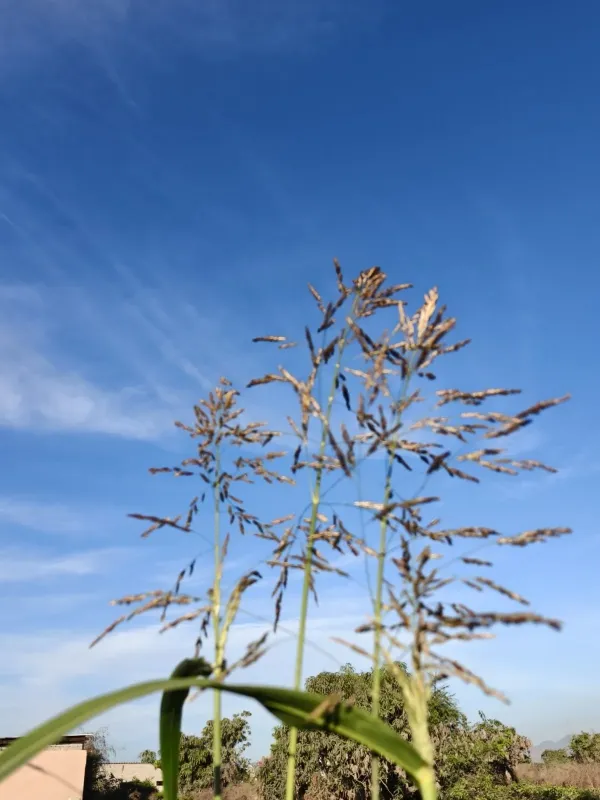
Johnsongrass, scientifically known as Sorghum halepense, is a vigorous perennial grass in the Poaceae family, recognized for its aggressive rhizomes.
It typically grows between 1 to 2 meters tall, characterized by thick stems and wide, flat leaves that often feature a prominent white midrib.
The inflorescence is a large, spreading panicle, which can display shades of green, purple, or deep red, making the plant visually distinct during its bloom.
This weed produces numerous seeds, but its primary means of invasion and persistence is its extensive network of fleshy, spreading rhizomes.
Even small pieces of these rhizomes can regenerate into new plants, making manual weeding or improper tilling methods counterproductive.
Where it grows
Johnsongrass is highly adaptable and thrives in warm, temperate, and tropical climates, favoring fertile soils with consistent moisture levels.
It is commonly found in cultivated fields, particularly those planted with corn, cotton, soybeans, and other row crops that require substantial space.
Beyond agricultural lands, it colonizes roadsides, ditch banks, and fallow areas, spreading seeds and rhizome fragments via water, wind, and equipment.
The plant is highly sensitive to frost, which limits its spread in northern regions, but it remains a dominant species in southern agriculture.
Disturbed soil environments, such as those caused by road construction or infrequent land management, provide ideal conditions for rapid colonization.
Harm it causes
Johnsongrass is considered one of the most problematic weeds globally because of its ability to outcompete crops for essential resources.
Its deep root system aggressively depletes soil moisture and nutrients, leading to stunted growth and significantly reduced yields in cash crops.
The plant possesses allelopathic properties, meaning it releases chemical substances into the soil that inhibit the germination and growth of other plants.
As a host for various diseases and insect pests, such as aphids and viruses, it poses a recurring phytosanitary threat to nearby crops.
In high densities, the thick stalks of this weed interfere with harvesting equipment, increasing operational downtime and damaging machinery components.
How to control
Cultural control involves systematic tillage, specifically using implements that bring rhizomes to the surface to desiccate them in the sun.
Crop rotation with competitive, dense-canopy crops can help shade out Johnsongrass seedlings and limit their growth potential over time.
Chemical control is often necessary, utilizing systemic herbicides like glyphosate on fallow fields to ensure translocation into the rhizomes.
- Application of selective graminicides during active growth phases in broadleaf crops.
- Preventative measures such as cleaning equipment to avoid spreading rhizome fragments.
- Early scouting and spot treatments to prevent localized patches from expanding.
Integrating chemical programs with effective mechanical practices is essential to exhaust the plant's energy reserves and achieve long-term suppression.
Content graph
Connections · Johnsongrass
Most often together:
Marketplace
Products · 48


Pantera
Кемарк КФТ, Угорщи (на замовлення Кемтура Корпорейшн, США)на
Herbicides
1
0
·
3.4K
27 offers
9 €per 1 l
Buy


Bagira Super
Ф.Меатон Лімітед, Лондон, Великобританія.
Herbicides
1
2
·
2.8K
5 offers
4.29 €per 1 l
Buy


Agil 100
F.A.GAN Chemical Manufacturers Ltd. Israel, member
Herbicides
0
0
·
2.3K
8 offers
5.03 €per 1 l
Buy


Quin Star
«Нанджин Ессенс Файн-Кемікал Ко. Лтд» (Китай)
Herbicides
2
0
·
2.3K
19 offers
1.83 €per 1 l
Buy



Selenit
«Нанджин Ессенс Файн-Кемікал Ко. Лтд» (Китай)
Herbicides
0
0
·
1.4K
4 offers
12.05 €per 1 l
Buy


Fusilade Forte 150 EC c.e.
Сингента Лімітед, Хаддерсфільд,Великоб-ританія
Herbicides
0
0
·
37
4 offers
27.56 €per 1 l
Buy


Maro
Superus Co., Ltd., Китай, Yangzhou Pioneer Chemical Co., Ltd., Китай
Herbicides
0
0
·
1.6K
No offers
—
Details
Shans
Superus Co., Ltd., Китай, Yangzhou Pioneer Chemical Co., Ltd., Китай
Herbicides
0
1
·
1.4K
No offers
—
Details


Centurion k.e. herbicide with surfactant 'Amigo'
Аріста ЛайфСайенс С.А.С., Ногер, Франція
Herbicides
0
0
·
46
No offers
—
Details
Biology
Taxonomy
- Latin name
- Sorghum halepense
- Family
- Многолетние злаковые