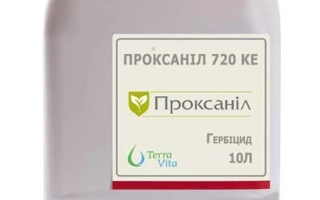
Proponit — herbicide for protecting rape, corn, and sunflower crops.
Arista LifeScience offers on the Ukrainian market a new product that blurs traditional boundaries between soil-applied and systemic herbicides — Proponit 720 EC. This herbicide, based on the active ingredient propizochlor, combines the best features of both soil-applied and systemic herbicides: high selectivity and efficacy, universal application, and a protective duration of at least 12 weeks.
The active ingredient propizochlor in Proponit is an inhibitor of germination and synthesis of nucleic acids and proteins. Rapid death of weeds occurs due to osmotic pressure reduction after damage to their root systems. Thanks to its unique mode of action, propizochlor ensures high efficacy of Proponit herbicide both pre-emergence and post-emergence (for corn and rape). It should be noted that Proponit, when applied pre-emergence, does not require incorporation into the soil. However, cultivation with light cultivators after Proponit application during prolonged drought enhances the herbicide’s efficacy.
When applied at recommended rates of 2.0-3.0 L/ha and working solution rate of 200-400 L/ha, Proponit is highly effective against all persistent annual grassy weeds prevalent in winter and spring rape crops under adequate moisture conditions: bird’s-foot trefoil, species of mouse, metel species of crabgrass, oats, goosegrass (from seeds), as well as major broadleaf species such as species of chickweed, Sophora japonica, creeping cinquefoil, common poppy, species of chamomile, species of nettle, common violet, starwort, common foxglove, species of chamomile, field chamomile, etc. In the case of sufficient moisture in the plow layer during autumn, Proponit on winter rape can control even field maple both pre-emergence and post-emergence.
Due to the ability of the active ingredient propizochlor to actively kill both germinating and already vegetating weeds at the time of spraying, it can be applied before or during sowing, as well as after emergence of rape when the crop is in the 2-4 leaf stage. Proponit reliably kills germinating weeds and suppresses the appearance of new weed flushes throughout the entire autumn and partially spring vegetation period of winter rape. When applied post-emergence, Proponit achieves the best effect against weeds when grassy weeds are in the 1-2 leaf stage, and broadleaf weeds are in the cotyledon stage.
In the case of the spread of cereal grasses on rape fields, using Proponit allows partially resolving this problem. A sufficient condition for the herbicide’s effectiveness against cereal grasses is synchronized emergence with rape plants. However, such circumstances are rare. Usually, cereal grasses emerge before winter rape plants and already have a developed root system that is not controllable by soil-applied herbicides. If their growth is delayed due to weather conditions and if cereal grasses appear in waves, it is advisable to use the grass herbicides Centurion from South Africa Amigo at a rate of 0.2-0.4 L/ha or Select — 0.4-0.8 L/ha. If a pre-emergence herbicide Proponit was applied at a rate of 2.5-3.0 L/ha, then cereal grasses will be suppressed and the efficacy of the grass herbicides will be maximized.
On fields where the herbicide Proponit was applied in autumn, the need for additional spring applications of systemic herbicides disappears. Usually, Proponit in winter rape crops retains its efficacy until April-May, when winter rape has formed a strong vegetative mass and fully dominates over weeds. Repeat application of narrow-spectrum herbicides may be required in case of spread of perennial root and rootstock weeds that are not controlled by Proponit or any other acetylene herbicide, for example, species of clover. In cases where cruciferous weeds and certain overwintering weeds are present in rape crops, the most justified and effective approach is autumn pre-emergence application of 2.5 L/ha Proponit in tank mixtures with a broadleaf herbicide based on the active ingredient cloquazol at a rate of 0.12-0.15 L/ha.
A characteristic feature of Proponit application is the absence of any phytotoxic effects on the crop even after heavy atmospheric precipitation. As is known, the appearance of phytotoxicity under high moisture conditions in the topsoil layer prevents the use of some acetylene herbicides in crops such as rape, sunflower, soybean, sugar beet, and others.
Initial steps of Proponit on the Ukrainian market have characterized the product as a reliable and highly effective tool for protecting rape, corn, sunflower, soybean, etc. crops.